 YAVE
Aston Villa
The history of Aston Villa: from a gas-lamp meeting to European champions and the Emery revival

Aston Villa were founded in 1874 by members of the Wesleyan chapel at Villa Cross in Handsworth, Birmingham — four cricketers, Jack Hughes, George Matthews, Walter Price and William Scattergood, who met under a gas lamp looking for a winter sport. Few clubs have shaped football itself as Villa have: their director William McGregor founded the Football League in 1888, and Villa are one of only three clubs to have been founding members of both the Football League and the Premier League.
The honours match that heritage: seven league titles, seven FA Cups, five League Cups and, on a famous night in Rotterdam in 1982, the European Cup. Villa Park, the club's home since 1897 and the largest ground in the Midlands, now holds 43,205 — temporarily reduced while its North Stand is redeveloped.
Contents
- Gas-Lamp Founders and the Ramsay Passing Game (1874–1886)
- The Victorian and Edwardian Golden Age (1886–1914)
- Post-War Decline, Record Goals and the Long Wait (1914–1961)
- Third-Tier Fall, Saunders Revival and European Champions (1961–1992)
- Premier League Founders, Near-Misses and Relegation (1992–2016)
- Championship Years and the Unai Emery Revival (2016–present)
- Honours
- Timeline
- References
Gas-Lamp Founders and the Ramsay Passing Game (1874–1886)
The club is believed to have been formed on 21 November 1874. Its first match was against the local Aston Brook St Mary's rugby team, played half under rugby rules and half under Association rules — and won 1–0 by Villa. A young Scotsman, George Ramsay, joined after a practice match in Aston Park in 1876, became captain and introduced the Scottish short-passing "combination game", revolutionary in England at the time. Villa's first honour was the Birmingham Senior Cup in 1880, lifted nine times in the next twelve seasons, and the club's early homes were Aston Park and then Wellington Road in Perry Barr.
The Victorian and Edwardian Golden Age (1886–1914)

Ramsay was appointed full-time manager in 1886, described as the world's first professional football manager. Villa won their first FA Cup in 1887, with Archie Hunter scoring in every round, and in 1888 McGregor founded the Football League, with Villa among its twelve members. After a boardroom purge in 1893, Ramsay's side dominated the decade: league titles in 1893–94, 1895–96, 1896–97, 1898–99 and 1899–1900, and FA Cups in 1895 and 1897 — the 1896–97 triumph completing the Double of League and FA Cup in the same season. That year the Double-winning side moved to the Aston Lower Grounds, the future Villa Park. Success continued into the Edwardian years with the FA Cup in 1905, a sixth league title in 1909–10 and another FA Cup in 1913. Ramsay's eventual haul was six League Championships and six FA Cups.
Post-War Decline, Record Goals and the Long Wait (1914–1961)
Villa won a sixth FA Cup in 1920, in Billy Walker's debut season — Walker became the star of the 1920s and finished as the club's record scorer with 244 goals. Ramsay retired in 1926, and Villa twice finished league runners-up to Arsenal in the early 1930s despite a goalscoring feat that still stands: in 1930–31 Villa scored 128 league goals, the all-time English top-flight record, 49 of them by Tom "Pongo" Waring, who scored 50 in all competitions that season. A first relegation came in 1935–36 after 48 years in the top flight; Villa bounced back as Second Division champions in 1937–38, but the war halted the revival.
The post-war years brought mediocrity, despite a record Villa Park crowd of 76,588 in 1946. The wait for a trophy ended in 1957, when Eric Houghton's side beat Manchester United's "Busby Babes" 2–1 in the FA Cup final, Peter McParland scoring both goals — the club's first trophy in 37 years. Relegation followed in 1959, but Joe Mercer's young "Mercer's Minors" won the Second Division in 1960 and, in 1961, became the first winners of the Football League Cup.
Third-Tier Fall, Saunders Revival and European Champions (1961–1992)

Decline deepened after Mercer left in 1964: relegation in 1967, a takeover by Doug Ellis, and in 1969–70 relegation to the Third Division for the only time in the club's history. Villa reached the League Cup final as a third-tier side in 1971 and won the Third Division title in 1971–72. Ron Saunders, appointed in 1974, rebuilt the club: the League Cup and promotion in 1975, the League Cup again in 1977, and in 1980–81 a seventh league title — the first in 71 years, won using just 14 players. Charlie Aitken, a mainstay through the fall and the rise, set the club appearance record of 660.
Saunders resigned in February 1982, midway through a European Cup run. His assistant Tony Barton took over and led Villa to the final in Rotterdam on 26 May 1982, where Peter Withe's goal beat Bayern Munich 1–0 — stand-in goalkeeper Nigel Spink, in only his second first-team game, keeping a clean sheet. The European Super Cup followed, beating Barcelona 3–1 on aggregate. Yet within five years of conquering Europe Villa were relegated, in 1987; Graham Taylor brought them straight back and to a league runners-up finish in 1989–90.
Premier League Founders, Near-Misses and Relegation (1992–2016)

Villa were founder members of the Premier League in 1992, and Ron Atkinson's side finished runners-up in its inaugural season before winning the League Cup in 1994. Brian Little's young side won the League Cup again in 1996 — the club's last English trophy for decades. John Gregory's team reached the 2000 FA Cup final, and under Martin O'Neill, from 2006, Villa finished sixth three seasons running and reached the 2010 League Cup final. But O'Neill's resignation in August 2010 began a slide through a succession of managers, and in 2015–16 Villa were relegated — their only Premier League relegation, ending 29 years in the top flight.
Championship Years and the Unai Emery Revival (2016–present)
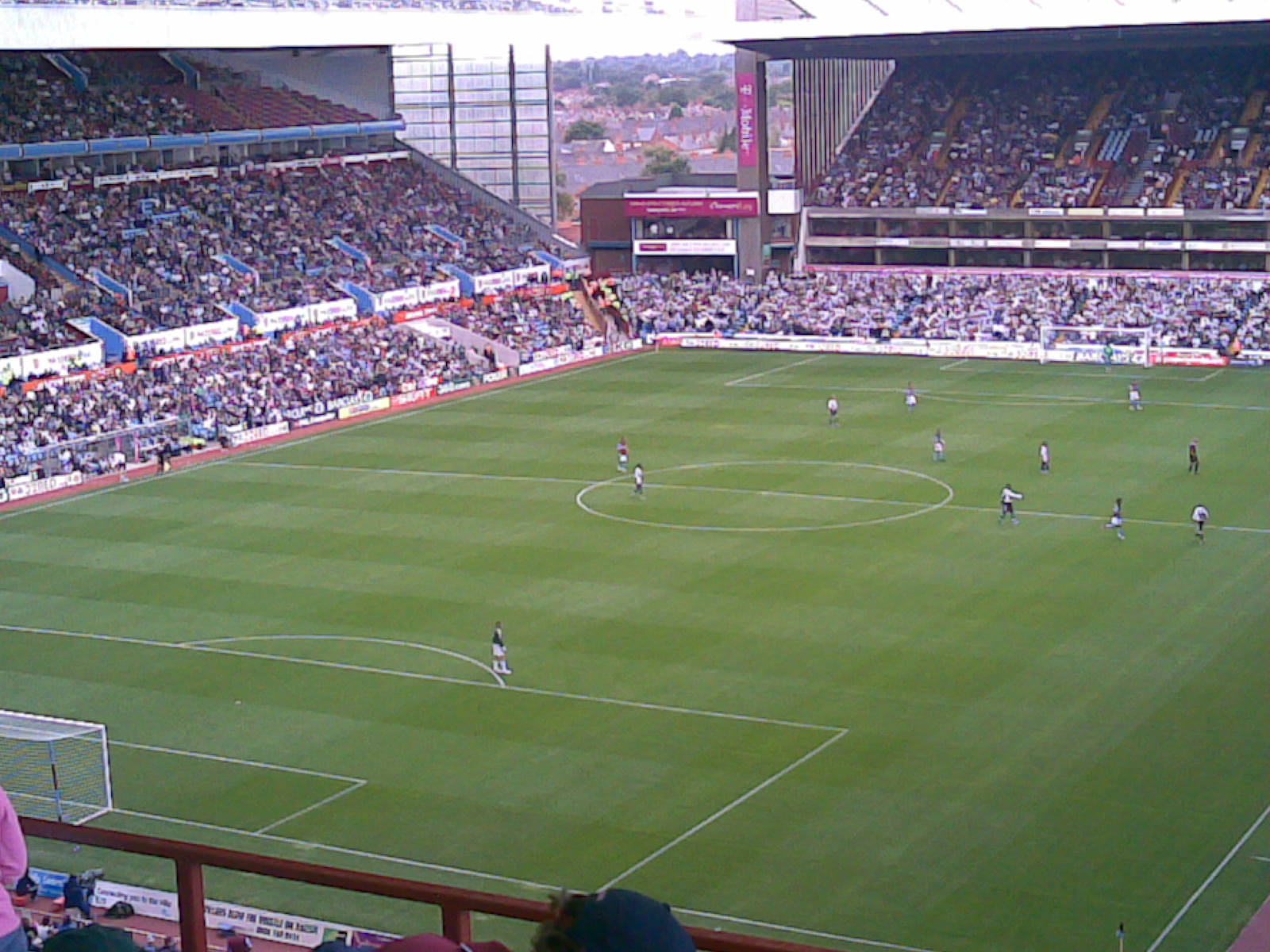
After three Championship seasons — and a play-off final defeat in 2018 — boyhood Villa fan Dean Smith won the 2019 play-off final against Derby County and restored the club to the Premier League, surviving on the final day in 2020. Jack Grealish was sold to Manchester City for a British-record £100 million in 2021, and a short spell under Steven Gerrard stalled. The transformation came with Unai Emery in October 2022: seventh place in his first season, then fourth in 2023–24, and in 2024–25 Champions League football returned to Villa Park for the first time since 1982–83 — including a famous home win over Bayern Munich — with a quarter-final run ended only by eventual winners Paris Saint-Germain. Off the pitch, Villa Park's capacity is 43,205, temporarily reduced to 36,887 in 2026–27 while the North Stand is redeveloped, with expansion to over 50,000 planned.
Honours
| Trophy | Titles | Years |
|---|---|---|
| League title (First Division) | 7 | 1893–94, 1895–96, 1896–97, 1898–99, 1899–1900, 1909–10, 1980–81 |
| FA Cup | 7 | 1887, 1895, 1897, 1905, 1913, 1920, 1957 |
| League Cup | 5 | 1961, 1975, 1977, 1994, 1996 |
| FA Charity Shield | 1 | 1981 (shared) |
| European Cup | 1 | 1982 |
| European Super Cup | 1 | 1982 |
| UEFA Intertoto Cup | 1 | 2001 (joint co-winners again in 2008) |
Villa's record scorer is Billy Walker, with 244 goals in 531 appearances between 1920 and 1934, and their record appearance maker is Charlie Aitken, with 660 appearances between 1959 and 1976. In 1930–31 Villa scored 128 league goals — still the all-time record for an English top-flight season — with Tom "Pongo" Waring scoring 50 goals in all competitions.
Timeline
- 1874 — Members of the Wesleyan chapel at Villa Cross, Handsworth, found the club (believed 21 November); founders Hughes, Matthews, Price and Scattergood meet under a gas lamp.
- 1887 — First FA Cup — Villa are the first Midlands club to win it; Archie Hunter scores in every round.
- 1888 — Villa director William McGregor founds the Football League; Villa are founder members.
- 1896–97 — The Double (League + FA Cup) under George Ramsay, and the move to the Aston Lower Grounds — Villa Park.
- 1930–31 — Villa score 128 top-flight goals, still the all-time record, but finish runners-up to Arsenal.
- 1957 — Seventh FA Cup, beating the "Busby Babes" — the club's first trophy in 37 years.
- 1961 — Villa become the first winners of the Football League Cup under Joe Mercer.
- 1980–81 / 1982 — Seventh league title under Ron Saunders; the following season Tony Barton's side win the European Cup in Rotterdam (1–0 vs Bayern Munich), then the European Super Cup.
- 1992–93 — Premier League founder members finish runners-up in its inaugural season under Ron Atkinson.
- 2016 / 2019 — Relegated from the Premier League in 2016; back up via the Championship play-offs under Dean Smith in 2019.
- 2024–25 — Unai Emery takes Villa into the Champions League for the first time since 1982–83, reaching the quarter-finals.
References
- Wikipedia — "Aston Villa F.C." (history, honours and records).
- Aston Villa FC — avfc.co.uk, official club history and honours pages.
- Premier League — official stadium guide (Villa Park capacity).
- Wikimedia Commons — file pages for the photographs used.
Image source: Wikimedia Commons.


