 YAVE
Athletic Bilbao
The Lions' Story — the Cantera Policy, Zarra, and the Gabarra's Return in 2024 (the club's official name is Athletic Club)

Athletic Club — the club's official name is simply Athletic Club; "Athletic Bilbao" is the name by which it is commonly known in English — were founded in 1898 in Bilbao, Biscay, by Basque students of the Gymnasium Zamacois together with British workers and residents who had brought football to the port city. Nicknamed Lehoiak, the Lions, and the Zuri-Gorriak, the Red-and-Whites, Athletic play at San Mamés: the original ground opened on 21 August 1913, and its replacement, opened in September 2013 on the same site, has a capacity of 53,289. Both grounds are known as "La Catedral", the Cathedral. Athletic are one of only four Spanish professional clubs still owned by their members, and a founder member of La Liga and one of only three clubs — with Real Madrid and Barcelona — never to have been relegated from the top flight.
What makes Athletic unique is the cantera policy. The club's sporting philosophy is governed by a code which states that the club may only field players who have come through its own academy or the academies of other clubs in the Basque Country, or players who were born in the territories which constitute the Basque Country: Biscay, Gipuzkoa, Alava, Navarre, Labourd, Soule and Lower Navarre. The policy is unwritten — a philosophy, not a statute — and has been in practice since 1911–12; it applies to players only, never to coaches. Athletic have won La Liga eight times and the Copa del Rey 24 times in the official RFEF count — second only to Barcelona; the club itself counts 25, including the 1902 Copa de la Coronación won by Club Bizcaya, the combined Bilbao side that preceded the merger, which the Spanish federation does not recognise as an official Copa del Rey. Telmo Zarra is Athletic's all-time top scorer with 335 goals in official competitions (1940–1955) — the figure published by the club — 251 of them in La Liga; José Ángel Iribar holds the appearance record with 614 appearances between 1962 and 1980.
Contents
- Foundation, Bizcaya and the First Cups (1898–1913)
- Cup Kings Between the Wars (1913–1936)
- The Zarra Years and Post-War Glory (1939–1956)
- Lean Decades and the 1977 UEFA Cup Final (1956–1982)
- Clemente's Double and the Long Wait (1982–2012)
- The New San Mamés and the 2024 Copa (2012–2024)
- Honours
- Timeline
- References
Foundation, Bizcaya and the First Cups (1898–1913)
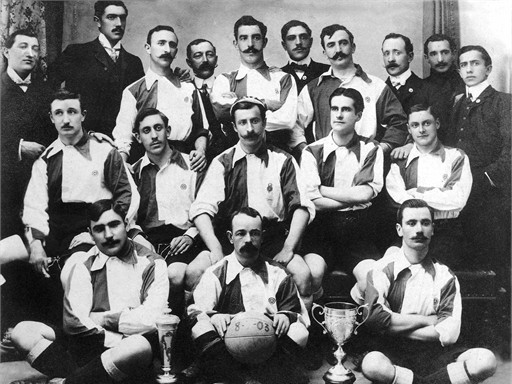
Football reached Bilbao through British shipyard and mining workers and Basque students returning from Britain, with early games played at Lamiako. In 1902 Athletic combined with city rivals Bilbao FC as Club Bizcaya to win the Copa de la Coronación in Madrid, beating Barcelona 2–1 in the final; on 24 March 1903 Bilbao FC was absorbed into Athletic. Athletic won the first official Copa del Rey in 1903, were awarded the 1904 cup when their opponents failed to appear, and won again in 1910 and 1911. From 1911–12 the club settled into its defining custom of fielding only Basque players. In 1903, Basque students in Madrid had founded Athletic Club Madrid — the future Atlético Madrid. The original San Mamés opened on 21 August 1913, with the great striker Pichichi scoring the first goal there on opening day.
Cup Kings Between the Wars (1913–1936)
Athletic won the Copa three years running from 1914 to 1916 and again in 1921 and 1923, and were founder members of La Liga in 1929. The first league titles followed immediately — 1929–30 and 1930–31 — along with four consecutive Copas between 1930 and 1933, a run no club had matched. In 1931 Athletic beat Barcelona 12–1, still the biggest win in La Liga history. Further league championships came in 1933–34 and 1935–36, before the Civil War stopped Spanish football and scattered the team.
The Zarra Years and Post-War Glory (1939–1956)

Under the Franco-era decree Hispanicising club names, Athletic were forced to play as Atlético Bilbao from 1941 until the original name was restored in the 1970s. The post-war side was built around Telmo Zarra, whose 251 La Liga goals stood as the league's all-time record for decades and whose 81 Copa del Rey goals remain a competition record. Athletic won the league in 1942–43 and three consecutive Copas from 1943 to 1945, then the Copa again in 1950 — with the Copa Eva Duarte the same year — and in 1955 and 1956, the last of those completing a league-and-cup double with the 1955–56 championship. Zarra retired in 1955 as the most prolific scorer Spanish football had seen.
Lean Decades and the 1977 UEFA Cup Final (1956–1982)

The league titles stopped after 1956, but the cup remained Athletic's territory: further Copas in 1958, 1969 and 1973. In Europe, the club's best European Cup run came at the first attempt, the 1956–57 quarter-finals, beating Manchester United 5–3 at San Mamés before losing the return 0–3. The era's emblem was goalkeeper José Ángel Iribar, who made 614 appearances between 1962 and 1980. The Lezama academy facilities opened in the 1971–72 season, giving the cantera policy a permanent home some 13 km from Bilbao. In 1976–77 Athletic reached the UEFA Cup final, losing to Juventus only on away goals after a 2–2 aggregate draw — the closest the club had come to a European trophy.
Clemente's Double and the Long Wait (1982–2012)
Under Javier Clemente, Athletic won La Liga in 1982–83 and completed the double in 1983–84, adding the Supercopa de España, which was awarded automatically to the double winners. The titles were celebrated in unique fashion: the team sailed down the Nervión estuary aboard the Gabarra, a flat-bottomed barge, before enormous crowds. Then the wait began. As Spanish football globalised, the cantera policy made competing harder, and although Athletic never fell — their worst La Liga finish is 17th, with narrow escapes in 2005–06 and 2006–07 — trophies dried up for three decades. Under Marcelo Bielsa the club reached a second European final, the 2011–12 Europa League final in Bucharest, but lost 0–3 to Atlético Madrid.
The New San Mamés and the 2024 Copa (2012–2024)

The new San Mamés opened in September 2013 beside its predecessor and was fully completed in August 2014. In 2015 Athletic beat Barcelona 5–1 on aggregate to win the Supercopa — the club's first trophy in 31 years — and won it again in January 2021, beating Real Madrid and Barcelona. Then, on 6 April 2024, came the night a generation had waited for: Athletic drew 1–1 with Mallorca in the Copa del Rey final in Seville and won the shoot-out 4–2, lifting the Copa for the first time in 40 years. On 11 April 2024 the Gabarra sailed the Nervión again, carrying the team and the trophy past crowds estimated in the hundreds of thousands — the supporters' motto made real: "Con cantera y afición, no hace falta importación" — with home-grown talent and local support, there is no need for imports.
Honours
| Competition | Titles | Years / notes |
|---|---|---|
| La Liga | 8 | 1929–30, 1930–31, 1933–34, 1935–36, 1942–43, 1955–56, 1982–83, 1983–84 |
| Copa del Rey | 24 | 1903, 1904, 1910, 1911, 1914, 1915, 1916, 1921, 1923, 1930, 1931, 1932, 1933, 1943, 1944, 1945, 1950, 1955, 1956, 1958, 1969, 1973, 1984, 2024 (official RFEF count; the club counts 25 including the 1902 Copa de la Coronación won by Club Bizcaya) |
| Supercopa de España | 3 | 1984, 2015, 2021 |
| Copa Eva Duarte | 1 | 1950 |
| European Cup / UEFA Champions League | 0 | Never won — best: quarter-finalists 1956–57 |
| UEFA Cup / UEFA Europa League | 0 | Never won — runners-up 1976–77, 2011–12 |
| Campeonato Regional del Norte | 5 | Regional titles |
| Campeonato Regional de Vizcaya | 12 | Regional titles |
| Copa Vasca | 1 | 1935–36 |
Timeline
- 1898 — Athletic Club founded in Bilbao by Basque students and British workers and residents.
- 1902 — Club Bizcaya, the combined Bilbao side, wins the Copa de la Coronación in Madrid.
- 1903 — Bilbao FC is absorbed into Athletic; the club wins the first official Copa del Rey.
- 1913 — The original San Mamés opens on 21 August; Pichichi scores the first goal there.
- 1929 — Founder member of La Liga.
- 1930 — First La Liga title (retained in 1931); four consecutive Copas follow, 1930–1933.
- 1931 — The record 12–1 win over Barcelona — still La Liga's biggest victory.
- 1943 — League champions again; three consecutive Copas, 1943–1945.
- 1956 — La Liga and Copa del Rey double.
- 1971 — The Lezama academy opens (1971–72 season).
- 1977 — UEFA Cup finalists, losing to Juventus on away goals.
- 1984 — League-and-cup double under Javier Clemente; the Gabarra sails the Nervión.
- 2013 — The new San Mamés opens in September.
- 2015 — Supercopa won against Barcelona — the club's first trophy in 31 years (won again in 2021).
- 2024 — Copa del Rey won on 6 April (1–1 v Mallorca, 4–2 on penalties), ending a 40-year wait; the Gabarra sails again on 11 April.
References
- Wikipedia — "Athletic Bilbao", "San Mamés Stadium (2013)".
- Athletic Club (athletic-club.eus) — "Our philosophy" (the cantera code); club records and San Mamés statistics.
- UEFA.com — club profile; Euro 2020 stadium evaluation (San Mamés capacity).
- Associated Press — reports of the 2024 Copa del Rey final and the Gabarra celebration.
- Wikimedia Commons — file pages for the photographs used.
Image source: Wikimedia Commons.


