 YAVE
Borussia Dortmund
Echte Liebe at the Yellow Wall: a pub founding, a Champions League, a brush with bankruptcy and a title lost on the last day
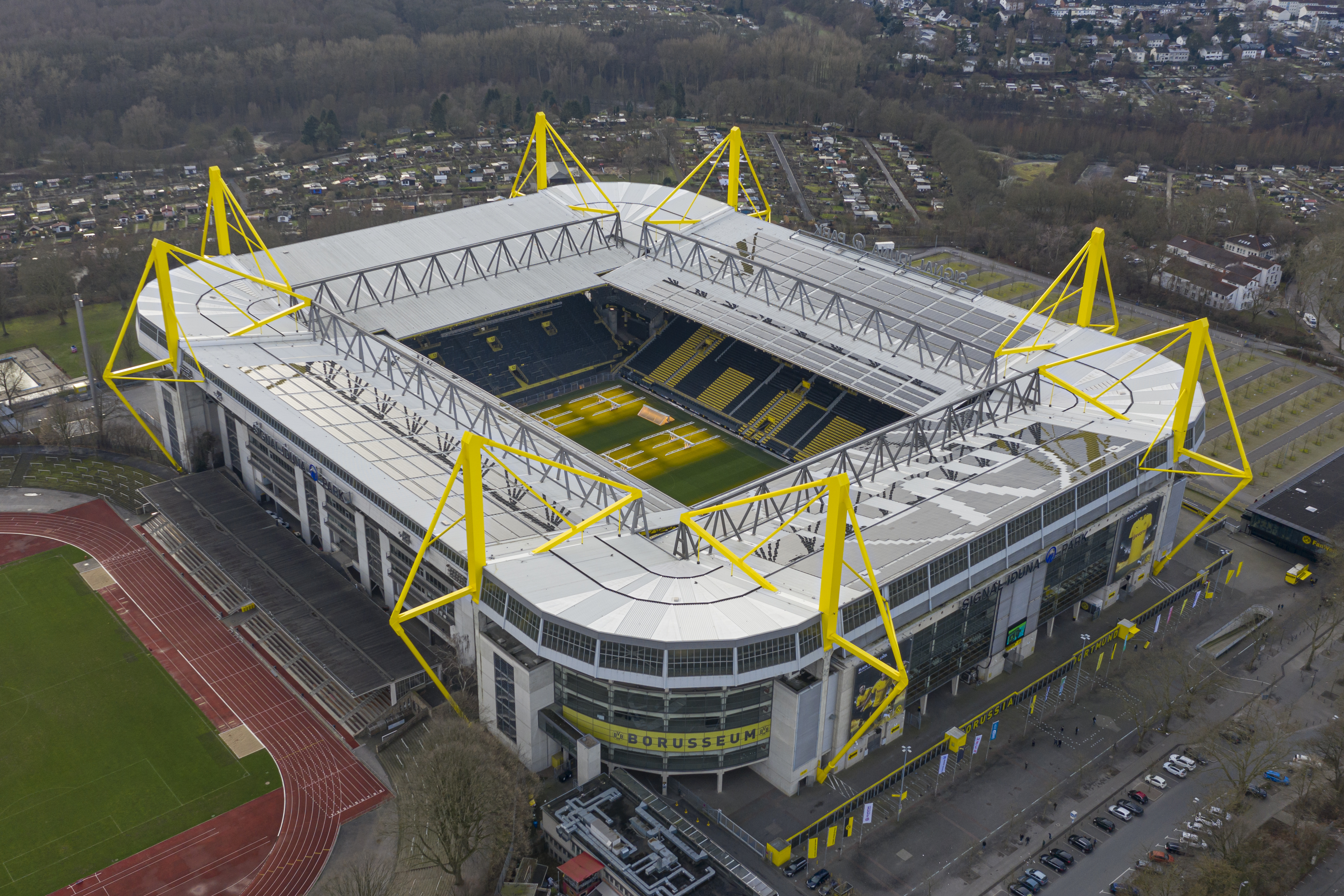
Borussia Dortmund are Die Schwarzgelben, the Black and Yellows of Dortmund, the largest city of the Ruhr — Die Borussen, whose motto is Echte Liebe, True Love. The club was founded on 19 December 1909 by eighteen young footballers in a room of the Zum Wildschütz pub at the Borsigplatz. "Borussia" is Latin for Prussia, but the founders took the name from Borussia beer, brewed at the Borussia brewery near the Borsigplatz. The founders played in blue-and-white stripes with a red sash; the black and yellow arrived only in 1913. Since 1974 their home has been the Westfalenstadion — Signal Iduna Park since December 2005 — holding 81,365 for domestic matches and 66,099 for international fixtures, its Südtribüne, the Yellow Wall, the largest standing terrace in European football with 24,454 places.
Dortmund have won eight German championships — three before the Bundesliga (1956, 1957, 1963) and five Bundesliga titles (1995, 1996, 2002, 2011, 2012), the two stars above the crest marking the five Bundesliga titles only. They have won five DFB-Pokals, six Supercups, the 1997 Champions League, the 1966 Cup Winners' Cup — the first European trophy won by a German club — and the 1997 Intercontinental Cup. Their history also holds a record 12–0 defeat, a near-collapse in 2005 and a title lost on the last day in 2023.
Contents
- A pub, a brewery and the long road to a first final (1909–1949)
- The three Alfredos and the last old-style championships (1949–1963)
- The Pokal, Glasgow glory and the fall (1963–1976)
- The big stadium, Burgsmüller and the long wait (1976–1991)
- Hitzfeld's golden age and Sammer's last title (1991–2002)
- Crash, rescue, Klopp and the near-misses (2002–2026)
- Honours
- Timeline
- References
1. A pub, a brewery and the long road to a first final (1909–1949)

The eighteen founders were young footballers of the Catholic Trinity Youth who had fallen out with their chaplain, Father Dewald, over his strict supervision of their football; Dewald was blocked at the door when he tried to break up the founding meeting. The club's first home was the Weiße Wiese near the Borsigplatz, and in 1937 Dortmund moved to the municipal Stadion Rote Erde. A first brush with bankruptcy came in 1929, when an attempt to professionalise by signing paid players left the club deep in debt and a local supporter covered the shortfall from his own pocket. In the Gauliga years Dortmund lived in Schalke's shadow — the root of the Revierderby — while members who used club offices to print anti-Nazi pamphlets were executed in the last days of the war. Dissolved in 1945, the club re-formed and reached its first national final in 1949, losing 2–3 after extra time to VfR Mannheim in Stuttgart.
2. The three Alfredos and the last old-style championships (1949–1963)
Dortmund dominated the Oberliga West, winning it six times, a record. The forward line of Alfred Preissler, Alfred Kelbassa and Alfred Niepieklo — the three Alfredos — fired the club to its first German championship in 1956, the final won 4–2 against Karlsruher SC, and the repeat in 1957, 4–1 against Hamburger SV. Preissler remains the club's record scorer in all competitions, with 177 goals in 274 appearances. A third title followed in 1963: on 29 June, in Stuttgart, Dortmund beat 1. FC Köln 3–1 in the last championship final of the pre-Bundesliga era. That summer Dortmund entered the new Bundesliga as founder members — and on 24 August 1963, one minute into the first matchday at Werder Bremen, Timo Konietzka scored the first goal in Bundesliga history.
3. The Pokal, Glasgow glory and the fall (1963–1976)

The first DFB-Pokal came on 22 May 1965, a 2–0 win over Alemannia Aachen in Hanover. A year later, on 5 May 1966 at Hampden Park, Willi Multhaup's side beat Liverpool 2–1 after extra time, Sigfried Held and Reinhard Libuda scoring — the first European trophy won by a German club. Lothar Emmerich was the Bundesliga's top scorer that season with 31 goals. But the 1965–66 league title was thrown away in the run-in, and decline followed: financial trouble and, in 1972, relegation. The Westfalenstadion opened on 2 April 1974, with a benefit match against Schalke, while the club was in the second division; promotion back followed in 1976.
4. The big stadium, Burgsmüller and the long wait (1976–1991)
The Bundesliga years in Germany's largest ground were mostly mid-table. Manfred Burgsmüller scored 135 goals in 224 Bundesliga matches — still the club's Bundesliga scoring record; in all competitions he stands fourth, behind Preissler, Marco Reus and Michael Zorc. Zorc, the club's record appearance holder with 572 appearances in all competitions and 463 in the Bundesliga, captained the side from 1988 to 1998. The low point came on 29 April 1978: a 0–12 defeat at Borussia Mönchengladbach, still the heaviest defeat in Bundesliga history. Survival in 1986 was secured only in a relegation play-off against Fortuna Köln, won at the third attempt. The long wait for a trophy ended under Horst Köppel in 1989: the DFB-Pokal, won 4–1 against Werder Bremen, and the Supercup, won 4–3 against Bayern — the first major trophies in 23 years. Ottmar Hitzfeld arrived in 1991.
5. Hitzfeld's golden age and Sammer's last title (1991–2002)

Hitzfeld's side were runners-up in 1992, Stuttgart taking the title on the final day, and lost the 1993 UEFA Cup final to Juventus, 1–6 on aggregate — a defeat that paradoxically bankrolled the squad through the era's prize-money pool. Back-to-back Bundesliga titles followed in 1995 and 1996 under captain Matthias Sammer, who won the Ballon d'Or in 1996. Then, on 28 May 1997 at the Olympiastadion in Munich, came the summit: Dortmund 3–1 Juventus in the Champions League final — Karl-Heinz Riedle scored twice, Alessandro Del Piero pulled one back, and 20-year-old substitute Lars Ricken, with his first touch 16 seconds after coming on, chipped the goalkeeper from over 20 yards to seal the win. In December 1997 Dortmund beat Cruzeiro 2–0 in Tokyo to win the Intercontinental Cup, Zorc scoring the first goal. In October 2000 the club floated on the stock market, the first publicly traded club in German football. In 2002, coach Matthias Sammer — the first man to win the Bundesliga with Dortmund as player and manager — took the title on the final day, overtaking Bayer Leverkusen, though the season ended with a UEFA Cup final defeat to Feyenoord.
6. Crash, rescue, Klopp and the near-misses (2002–2026)
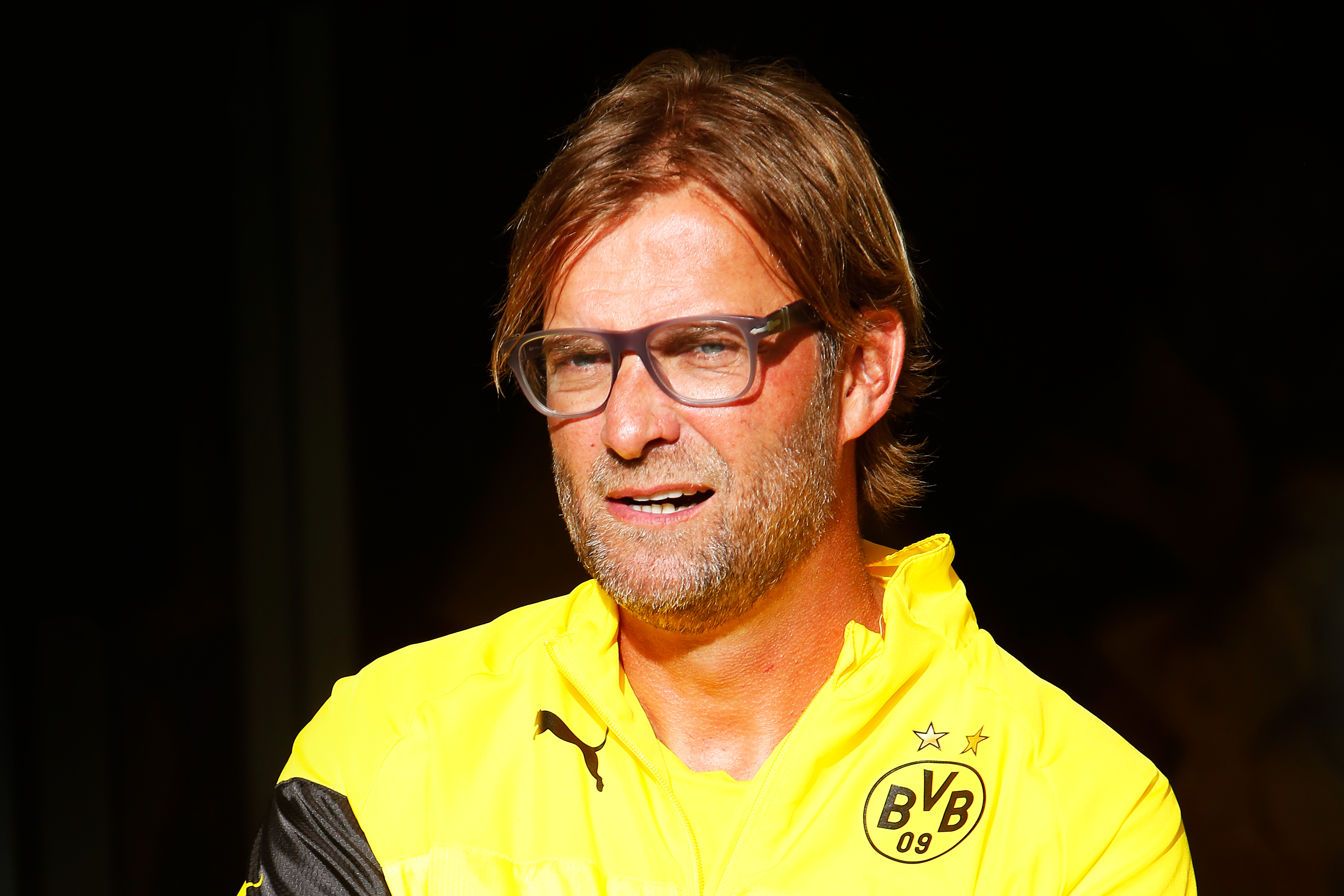
The flotation money funded an expensive squad and stadium expansion, and the structure collapsed: 94% of the stadium was sold to a real-estate fund in 2002, and in 2003 Bayern lent Dortmund €2 million to meet the payroll. In November 2004 the club presented liabilities of €118.8 million, equity shrunk from €150 million to €25 million; on 14 March 2005 the creditors agreed a restructuring that averted insolvency. Hans-Joachim Watzke, chief executive from 2005, imposed austerity: a 20% wage cut, star sales, the stadium bought back in 2006. Jürgen Klopp, appointed in 2008, rebuilt with youth: the Bundesliga in 2010–11, sealed on 30 April 2011, and in 2011–12 a then-record 81 points and the club's first double, the Pokal won 5–2 against Bayern. In 2013 Dortmund lost the first all-German Champions League final, 1–2 to Bayern at Wembley. The post-Klopp years brought runners-up finishes in 2016, 2019, 2020 and 2022; the 2017 Pokal, won weeks after three explosive devices detonated beside the team bus before the Monaco quarter-final, injuring Marc Bartra; and the 2021 Pokal under caretaker Edin Terzić. On 27 May 2023 Dortmund began the final day top, drew 2–2 at home with Mainz 05, and lost the title to Bayern on goal difference. In 2024 Terzić took a fifth-placed side back to Wembley, losing the Champions League final 0–2 to Real Madrid. Niko Kovač, appointed on 2 February 2025, recovered fourth place that season; Watzke was elected club president in November 2025. Dortmund ended the 2025–26 season second in the Bundesliga with 73 points and the division's best defensive record — their 50th consecutive season in the top flight — having lost to Atalanta in the Champions League knockout-phase play-offs and reached the last sixteen of the DFB-Pokal.
Honours
| Competition | Success | Notes |
|---|---|---|
| German championship | Champions 1956, 1957, 1963, 1995, 1996, 2002, 2011, 2012 | Three pre-Bundesliga titles plus five Bundesliga titles; runners-up nine times |
| DFB-Pokal | Winners 1965, 1989, 2012, 2017, 2021 | Five wins; runners-up in 1963, 2008, 2014, 2015 and 2016 |
| European Cup / Champions League | Winners 1996–97 | Beat Juventus 3–1 in Munich; runners-up in 2013 and 2024, both at Wembley |
| European Cup Winners' Cup | Winners 1965–66 | Beat Liverpool 2–1 after extra time at Hampden Park — the first European trophy won by a German club |
| Intercontinental Cup | Winners 1997 | Beat Cruzeiro 2–0 in Tokyo; the second German club to win it, after Bayern |
| UEFA Cup | Finalists 1993, 2002 | Lost to Juventus (1–6 agg) and Feyenoord |
| DFB/DFL-Supercup | Winners 1989, 1995, 1996, 2013, 2014, 2019 | Six wins |
Timeline
- 1909 — 19 December: eighteen young footballers found the Ballspielverein Borussia 09 in a room of the Zum Wildschütz pub at Dortmund's Borsigplatz; the name comes from Borussia beer.
- 1913 — Black-and-yellow stripes adopted (the founders had played in blue and white with a red sash).
- 1929 — A failed attempt to sign paid professionals leaves the club near bankruptcy; a supporter's private money saves it.
- 1937 — Dortmund move from the Weiße Wiese to the municipal Stadion Rote Erde.
- 1945 — The club is dissolved by the Allied authorities and re-forms as Ballspiel-Verein Borussia.
- 1949 — First national championship final: Dortmund lose 2–3 after extra time to VfR Mannheim in Stuttgart.
- 1956 — First German championship: 4–2 v Karlsruher SC in the final.
- 1957 — Second championship: 4–1 v Hamburger SV; the three Alfredos become legend.
- 1963 — 29 June: third championship, 3–1 v 1. FC Köln in Stuttgart — the last title of the pre-Bundesliga era; Dortmund enter the new Bundesliga as founder members.
- 1963 — 24 August: Timo Konietzka scores the first goal in Bundesliga history, at Werder Bremen.
- 1965 — 22 May: first DFB-Pokal: 2–0 v Alemannia Aachen in Hanover.
- 1966 — 5 May: European Cup Winners' Cup final, Hampden Park: Dortmund 2–1 Liverpool after extra time — the first European trophy won by a German club.
- 1972 — Relegated from the Bundesliga.
- 1974 — 2 April: the Westfalenstadion opens with a benefit match against Schalke 04.
- 1976 — Promotion back to the Bundesliga.
- 1978 — 29 April: the record defeat: 0–12 at Borussia Mönchengladbach.
- 1986 — Bundesliga survival secured in the relegation play-off against Fortuna Köln, at the third attempt.
- 1989 — DFB-Pokal won (4–1 v Werder Bremen) and the Supercup (4–3 v Bayern) — the first major trophies in 23 years.
- 1995 / 1996 — Back-to-back Bundesliga titles under Ottmar Hitzfeld, captained by Matthias Sammer (Ballon d'Or 1996).
- 1997 — 28 May: Champions League final, Munich: Dortmund 3–1 Juventus — European champions. 2 December: Intercontinental Cup, Tokyo: Dortmund 2–0 Cruzeiro.
- 2000 — October: Borussia Dortmund GmbH & Co. KGaA floats on the stock market — the first publicly traded club in German football.
- 2002 — The 2001–02 Bundesliga title, won on the final day under coach Matthias Sammer; UEFA Cup final lost to Feyenoord. The stadium is sold to a real-estate fund.
- 2003 — Bayern Munich lend Dortmund €2 million to meet the payroll.
- 2004 — November: liabilities of €118.8 million are presented; equity has shrunk from €150 million to €25 million.
- 2005 — 14 March: creditors agree a restructuring; insolvency — and forced relegation to amateur football — is averted.
- 2006 — The club buys back its stadium; the ground carries the name Signal Iduna Park from 1 December 2005.
- 2011 — 30 April: the 2010–11 Bundesliga title sealed with a 2–0 win over Nürnberg.
- 2012 — The double: the 2011–12 championship with a then-record 81 points, and the DFB-Pokal (5–2 v Bayern).
- 2013 — 25 May: Champions League final, Wembley: Dortmund 1–2 Bayern — the first all-German final.
- 2017 — 11 April: the team bus is attacked with explosive devices before the Monaco quarter-final; Marc Bartra is injured. Weeks later Dortmund win the DFB-Pokal (2–1 v Eintracht Frankfurt).
- 2021 — Fifth DFB-Pokal: 4–1 v RB Leipzig under caretaker coach Edin Terzić.
- 2023 — 27 May: final day — a 2–2 home draw with Mainz costs Dortmund the title; Bayern are champions on goal difference.
- 2024 — 1 June: Champions League final, Wembley: Dortmund 0–2 Real Madrid. Terzić resigns days later.
- 2025 — 2 February: Niko Kovač takes over as head coach; Dortmund recover to finish 4th. November: Hans-Joachim Watzke, CEO since 2005, is elected president of the club.
- 2026 — May: Dortmund end the 2025–26 season 2nd in the Bundesliga (73 points, the league's best defence) — their 50th consecutive top-flight season.
References
- Borussia Dortmund — club history, honours and records, cross-checked between the English and German reference records of the club and the club's official site bvb.de (foundation 19 December 1909; the Westfalenstadion record — opened 2 April 1974, capacity 81,365 domestic and 66,099 international, the Südtribüne holding 24,454), bundesliga.com, UEFA.com and the ESMT Berlin case study on the 2004–05 financial crisis (liabilities of €118.8 million presented in November 2004; the creditors' restructuring of 14 March 2005).
- The records, scope-locked: all competitions — Michael Zorc 572 appearances, Alfred Preissler 177 goals in 274 appearances, Marco Reus 170 goals, Zorc 159; Bundesliga only — Zorc 463 appearances, Manfred Burgsmüller 135 goals in 224 matches. Membership of about 218,000 is the figure reported in November 2024.
Image source: Wikimedia Commons.


