YAVE
Borussia Mönchengladbach
The Foals who ruled the seventies: five titles in eight years, Netzer's self-substitution and a 12–0 that won nothing

Borussia Mönchengladbach are Die Fohlen, the Foals — Die Elf vom Niederrhein, the Team from the Lower Rhine — of Mönchengladbach in North Rhine-Westphalia. The club's official founding date is 1 August 1900, when the players who had broken away from Sportverein Germania in November 1899 registered as Fußballklub Borussia 1900. "Borussia" is the Latin name for Prussia. Since 2004 their home has been Borussia-Park, holding 54,042 for Bundesliga matches. The club's greatest figures are its own: manager Hennes Weisweiler, captain Berti Vogts, and Günter Netzer, the playmaker who once substituted himself on and scored the winner in a cup final.
Gladbach have won five Bundesliga titles — 1970, 1971, 1975, 1976, 1977 — and no pre-Bundesliga national championship. They have won three DFB-Pokals (1960, 1973, 1995), two UEFA Cups (1975, 1979) and lost the 1977 European Cup final to Liverpool. The club has never gone bankrupt or been refounded: the Fohlenelf of the 1970s, playing fast, young, attacking football at the little Bökelberg, remains the standard against which every later Gladbach side is measured.
Contents
- A pub split, a Latin name and the VfTuR years (1900–1945)
- Post-war yo-yo, a first Pokal and the birth of the Foals (1945–1965)
- Bundesliga breakthrough: back-to-back titles, a broken post and a thrown can (1965–1973)
- The golden age: three straight titles, two UEFA Cups and Rome (1973–1980)
- The long fade at the little Bökelberg (1980–2004)
- Borussia-Park, relegation and the Favre revival (2004–2026)
- Honours
- Timeline
- References
1. A pub split, a Latin name and the VfTuR years (1900–1945)
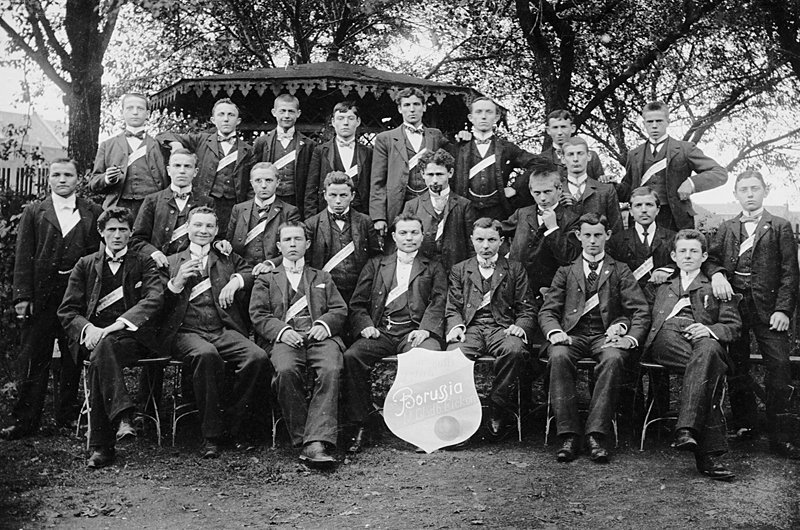
On 17 November 1899 a group of players left Sportverein Germania after a dispute and met at the Antoniusbräu inn in the Eicken district; on 1 August 1900 they registered their own club, Fußballklub Borussia 1900. The name chain that followed reflects German sport's turbulent structures: in 1919 Borussia merged into Turngemeinde 1889 as VfTuR 1889; in 1921 the footballers left as Borussia VfL 1900 e.V.; a forced merger under the Nazis in 1933 created SC Borussia, dissolved and reversed in 1934; and when the city of München-Gladbach was renamed Mönchengladbach in 1960, the club took its modern name. The honours of the era were regional — the 1920 West German championship was a regional title, not a national one — and the club's home from 1919 was the Bökelberg, handed over by the city in the mid-1950s. There was no national championship before the Bundesliga; everything Gladbach won, they won after 1965.
2. Post-war yo-yo, a first Pokal and the birth of the Foals (1945–1965)
Post-war Gladbach yo-yoed between the Oberliga West and the second division. The breakthrough off the pitch came first: on 5 October 1960, Borussia beat Karlsruher SC 3–2 in Düsseldorf to win the DFB-Pokal — the club's first national trophy. On the pitch, the future arrived in 1964: Hennes Weisweiler became head coach and built a side of teenagers and very young players — Berti Vogts, Günter Netzer, Herbert Laumen. Their pace and lightness earned them the nickname that stuck: die Fohlenelf, the Foals' Eleven. In 1965 the Foals won promotion to the Bundesliga.
3. Bundesliga breakthrough: back-to-back titles, a broken post and a thrown can (1965–1973)

Weisweiler's young side finished third in 1968 and 1969, then won back-to-back Bundesliga titles in 1969–70 and 1970–71 — the first club to defend the Bundesliga championship. The era produced two of German football's strangest matches. On 3 April 1971, against Werder Bremen, the wooden goalpost snapped in the 88th minute — the Pfostenbruch; the match was abandoned, awarded 2–0 to Bremen, and the DFB ordered aluminium posts across the league. On 20 October 1971, Gladbach beat Inter Milan 7–1 at the Bökelberg in the European Cup — and the result was annulled after an empty Coca-Cola can thrown from the crowd struck Inter's Roberto Boninsegna; the severity of Boninsegna's condition was disputed at the time and remains so, Inter's camp treating him as incapacitated and Gladbach's as play-acting; the Milan leg was then lost 4–2 and the replay ordered in Berlin finished 0–0, so Gladbach went out. In 1973 Gladbach reached the UEFA Cup final, losing to Liverpool, and won the DFB-Pokal instead: the final against Köln on 23 June 1973, won 2–1 after extra time, was decided by Netzer himself — benched, he substituted himself on with the words "I'll play now" and, three minutes later, in the 94th minute, drove a mishit shot in off the upright: the Goal of the Year, in his last match for the club before Real Madrid.
4. The golden age: three straight titles, two UEFA Cups and Rome (1973–1980)

Udo Lattek succeeded Weisweiler in 1975 and delivered the golden run: three consecutive Bundesliga titles in 1975, 1976 and 1977, with Jupp Heynckes — the club's record scorer, 195 goals in the Bundesliga and 298 in all competitions — leading the line. Europe followed: the UEFA Cup in 1975, FC Twente beaten 5–1 on aggregate in the final; the European Cup final in Rome on 25 May 1977, lost 1–3 to Liverpool; and, with Liverpool declining to play, Gladbach stood in for them in the 1977 Intercontinental Cup, losing to Boca Juniors. In 1979 Heynckes, now the coach, won the UEFA Cup again, Red Star Belgrade beaten 2–1 on aggregate — the club's last European trophy. The league produced one final thunderclap: on 29 April 1978 Gladbach beat Borussia Dortmund 12–0, still the Bundesliga's record win — and still lost the title to Köln on goal difference. In 1980 came the last European final: the UEFA Cup against Eintracht Frankfurt, lost on away goals at 3–3 on aggregate, after a 3–2 win in the home leg and a 1–0 defeat in Frankfurt, Fred Schaub scoring. Vogts's appearance records anchor the era's statistics: 419 Bundesliga appearances and 538 in all competitions. Uli Kamps made 457 league appearances for the club across the two divisions — 390 of them in the Bundesliga, a figure that must never be quoted as his Bundesliga total.
5. The long fade at the little Bökelberg (1980–2004)
The Bökelberg held just 34,500 by the end, and Gladbach could not compete financially with the big-city clubs. The 1980s brought near-misses — Pokal finals lost in 1984 and 1992, and the 1985 Cup Winners' Cup run — and a production line of talent sold on: Lothar Matthäus, Stefan Effenberg. Heynckes coached the side from 1979 to 1987, his first great coaching spell. The last trophy of the old ground came in 1995: the DFB-Pokal, won 3–0 against VfL Wolfsburg — though that summer's Supercup was lost 0–1 to Dortmund. In 1999 came the first relegation, bottom of the table; promotion followed in 2001 under Hans Meyer. The Bökelberg's last match was played on 22 May 2004, a 3–1 win over 1860 Munich; the ground was demolished in 2006, and housing stands there now.
6. Borussia-Park, relegation and the Favre revival (2004–2026)

Borussia-Park opened on 30 July 2004 with a tournament involving Bayern Munich and AS Monaco. The new era began badly: relegation again in 2007, under a returning Heynckes whose second spell lasted from May 2006 to January 2007, then the 2. Bundesliga championship in 2008 under Jos Luhukay. The defining modern rescue came from Lucien Favre, appointed in February 2011 with the club bottom: survival was won in the 2011 relegation play-off against Bochum (1–0 and 1–1), and a year later Gladbach finished fourth. Favre's side finished third in 2014–15 and played Champions League football; Marco Rose took them fourth in 2019–20. Since then the club has settled into mid-table: the 2025–26 season closed with 12th place in the Bundesliga on 38 points — Gerardo Seoane dismissed in September 2025, Eugen Polanski completing the season — a campaign that included a 6–4 defeat at Frankfurt, a 1–5 home defeat by Wolfsburg and a 3–0 win over Leipzig. Membership stood at 111,250 in July 2026. The titles of the 1970s remain unrepeated, and Borussia-Park has never seen a trophy — but the Foals' identity, young players and attacking football, survives every rebuild.
Honours
| Competition | Success | Notes |
|---|---|---|
| Bundesliga | Champions 1969–70, 1970–71, 1974–75, 1975–76, 1976–77 | Five titles, all between 1970 and 1977; the first club to defend the Bundesliga title; no pre-Bundesliga national championship |
| DFB-Pokal | Winners 1959–60, 1972–73, 1994–95 | Beat Karlsruhe (1960), Köln with Netzer's self-substituted winner (1973) and Wolfsburg (1995); runners-up in 1984 and 1992 |
| UEFA Cup | Winners 1974–75, 1978–79 | Beat Twente and Red Star Belgrade; finalists in 1973 (lost to Liverpool) and 1980 (lost to Frankfurt on away goals) |
| European Cup | Finalists 1976–77 | Lost 1–3 to Liverpool in Rome |
| Intercontinental Cup | Finalists 1977 | Runners-up to Boca Juniors, playing as Liverpool's stand-ins |
| 2. Bundesliga | Champions 2007–08 | Promoted straight back after the 2007 relegation; also promoted in 1965 and 2001 |
| DFB/DFL-Supercup | Finalists 1995 | Lost 0–1 to Borussia Dortmund |
Timeline
- 1899 — 17 November: the Eicken breakaway — players leave Sportverein Germania after a dispute, meeting at the Antoniusbräu inn.
- 1900 — 1 August: Fußballklub Borussia 1900 registered — the club's official founding date.
- 1919 — Borussia merge into Turngemeinde 1889 as VfTuR 1889; the Bökelberg becomes home.
- 1921 — The footballers leave the merger as Borussia VfL 1900 e.V.
- 1933 / 1934 — A forced merger creates SC Borussia (1933); dissolved and reversed a year later.
- 1960 — The city is renamed Mönchengladbach and the club takes its modern name. 5 October: first national trophy — the DFB-Pokal, 3–2 v Karlsruher SC in Düsseldorf.
- 1964 — Hennes Weisweiler becomes head coach.
- 1965 — Promotion to the Bundesliga; the young side is nicknamed die Fohlenelf, the Foals' Eleven.
- 1970 — First Bundesliga title; defended in 1971 — the first successful title defence in Bundesliga history.
- 1971 — 3 April: the Pfostenbruch — a wooden goalpost snaps against Werder Bremen; the match is abandoned and awarded to Bremen. 20 October: the Büchsenwurfspiel — the 7–1 win over Inter is annulled after a thrown can strikes Boninsegna; the tie is lost after a 4–2 defeat in Milan and a 0–0 replay in Berlin.
- 1973 — UEFA Cup finalists (lost to Liverpool). 23 June: the DFB-Pokal won — 2–1 aet v Köln, Netzer substituting himself on and scoring the 94th-minute winner.
- 1975 — Third title, and the first UEFA Cup: Twente beaten 5–1 on aggregate in the final.
- 1976 — Fourth consecutive-season title (1975–76).
- 1977 — Fifth title. 25 May: the European Cup final in Rome lost 1–3 to Liverpool. Gladbach then play the Intercontinental Cup as Liverpool's stand-ins, losing to Boca Juniors.
- 1978 — 29 April: the record Bundesliga win, 12–0 v Borussia Dortmund — and the title is lost to Köln on goal difference.
- 1979 — Second UEFA Cup: Red Star Belgrade beaten 2–1 on aggregate; Jupp Heynckes becomes head coach.
- 1980 — UEFA Cup final lost to Eintracht Frankfurt on away goals (3–3 agg).
- 1995 — Third DFB-Pokal: 3–0 v VfL Wolfsburg. The Supercup is lost 0–1 to Dortmund.
- 1999 — First relegation, bottom of the Bundesliga; promoted back in 2001.
- 2004 — 22 May: the last match at the Bökelberg (3–1 v 1860 Munich). 30 July: Borussia-Park opens.
- 2007 — Second relegation; 2. Bundesliga champions and straight back in 2008.
- 2011 — Lucien Favre's rescue: survival in the relegation play-off v Bochum; fourth place in 2011–12.
- 2015 — Third place and Champions League football under Favre.
- 2020 — Fourth place under Marco Rose.
- 2026 — Twelfth in the Bundesliga (38 points); membership stands at 111,250 (July 2026).
References
- Borussia Mönchengladbach — club history, honours and records, cross-checked between the English and German reference records of the club and the club's official site borussia.de (official founding 1 August 1900; the Borussia-Park record — opened 30 July 2004, capacity 54,042 for Bundesliga matches), bundesliga.com, UEFA.com and DFB reporting on the 1960, 1973 and 1995 DFB-Pokal finals.
- The records, scope-locked: Bundesliga only — Berti Vogts 419 appearances, Jupp Heynckes 195 goals; all competitions — Vogts 538 appearances, Heynckes 298 goals in 417 appearances. Uli Kamps's 457 league appearances span both divisions (390 Bundesliga, 67 second-tier) and are printed only in that form; no single all-competitions total is printed for him, because the counts conflict (518 and 508 both appear in the sources).
Image source: Wikimedia Commons.