 YAVE
FC Augsburg
Haller's club: a 1969 merger, one point from the Bundesliga, a lost licence — and a stubborn establishment

FC Augsburg are the Fuggerstädter, the club of the Fugger city of Augsburg in Bavarian Swabia — a club whose roots reach back to 8 August 1907, when FC Alemannia Augsburg was founded on the day of the city's Hoher Friedensfest, but whose modern form was created by a merger on 15 July 1969. Since 2009 they have played at the WWK Arena, capacity 30,660 (19,060 seats and 11,034 standing), after nearly six decades at the Rosenaustadion.
Augsburg have never won a major trophy. Their honours are a best Bundesliga finish of fifth in 2014–15, a DFB-Pokal semi-final in 2010, two Regionalliga Süd championships won 32 years apart, and — the club's only national title at any level — the German Under-19 championship of 1993, a youth title. Their story is one of a great player, Helmut Haller, a merger that took decades to be accepted, a licence refusal that nearly finished them, and a late, stubborn arrival among the Bundesliga's established clubs.
Contents
- Alemannia, the gymnastics club and the birth of BCA (1907–1945)
- Oberliga yo-yo, Haller's emergence and the road to merger (1945–1969)
- The merger club, Haller's return and one point from the Bundesliga (1969–1979)
- The Bayernliga decades (1979–2000)
- Seinsch, the new arena and the long climb back (2000–2011)
- The Bundesliga establishment (2011–2026)
- Honours
- Timeline
- References
1. Alemannia, the gymnastics club and the birth of BCA (1907–1945)

FC Alemannia Augsburg was founded on 8 August 1907, the day of the Hoher Friedensfest, Augsburg's own public holiday. In 1909 the young club placed itself under the wing of the gymnastics club TV Oberhausen as its football section; in 1919 the footballers took the name Ballspiel-Club Augsburg — BC Augsburg — and on 30 August 1921 BCA became independent of the gymnastics club altogether. In the 1920s BCA won Kreisliga Schwaben titles in 1928, 1929, 1932 and 1933 without ever winning promotion, reached the Gauliga Bayern in 1934 and stayed until 1939, and in 1939–40 finished as Gauliga runners-up behind 1. FC Nürnberg — their best pre-war finish. The war brought combined teams: a KSG with city rivals TSV Schwaben, dissolved in November 1939, and KSG BC/Post in 1943–44. Across the city, Schwaben's star was Ernst Lehner — a great of the age, but Schwaben's player, never an Augsburg predecessor's in the modern club's line: the "FC Augsburg" that existed between 1908 and 1925 belonged to Schwaben's family, not to Alemannia's, and the modern FCA carries BCA's tradition alone.
2. Oberliga yo-yo, Haller's emergence and the road to merger (1945–1969)

BCA and Schwaben were both founder members of the Oberliga Süd in 1945, but BCA's post-war years were a yo-yo: relegations in 1947 and 1951, and the opening of the Rosenaustadion on 16 September 1951, a ground built on the rubble of the war with an official capacity of 28,000. On 9 November 1952 West Germany beat Switzerland 5–1 there before a crowd of almost 65,000 — the famous "Augsburger Elf" international. From BCA's youth emerged Helmut Haller, who broke into the first team in 1957, won his first West Germany cap in 1958, and in 1962 left for Bologna — one of the first Germans to star in Italy. Uli Biesinger, another Augsburger, was in the 1954 World Cup squad. When the Bundesliga was founded in 1963 there was no place for Augsburg: BCA started in the Regionalliga Süd, Schwaben lower still, and both slid — BCA into third-tier football by 1967–69, carrying debts. Twenty years of merger talks finally succeeded: on 15 July 1969 BCA merged with TSV Schwaben's licensed players' department — Schwaben itself remained an independent club — to form FC Augsburg 1907.
3. The merger club, Haller's return and one point from the Bundesliga (1969–1979)

The merger club's birth was difficult — a fourth-place finish, tiny crowds, a city slow to accept FCA. Bayernliga champions in 1972–73 took them into the Regionalliga Süd, and in 1973 Haller came home: after eleven years in Italy — a Serie A title with Bologna in 1963–64, won in a play-off against Inter, two more with Juventus in 1971–72 and 1972–73, a European Cup final in 1973, and 33 West Germany caps with 13 goals, including the opening goal of the 1966 World Cup final — he returned for a reported fee of DM 44,000. The newly promoted side won the Regionalliga Süd championship of 1973–74, the second tier's title that season; 42,000 packed the Rosenaustadion for the Nürnberg match, a club record home crowd, and the away match at 1860 Munich drew a crowd put at 80,000 or more — thousands forced their way in after kick-off, estimates run above 90,000, and 136 people were injured; it remains a second-division record crowd, and home attendances averaged over 20,000. In the promotion round FCA finished second in their group, one point behind Tennis Borussia Berlin, and missed the Bundesliga. Five seasons in the 2. Bundesliga Süd followed; Haller spent a year at Schwenningen, returned for a final spell, and retired in 1979 shortly before his 40th birthday, the year relegation came.
4. The Bayernliga decades (1979–2000)
The 1980s opened with a yo-yo: two Bayernliga titles, two immediate relegations, survival missed by three goals in 1983, and the club's chronic early-1980s debts laid bare when tax officials processed the gate receipts of the 1982 Homburg play-off. Eleven straight third-tier seasons followed from 1983 to 1994, runners-up in 1985 the closest brush; a famous cup tie in 1986, when FCA won 5–1 at 1860 and then lost 1–2 to Hamburger SV in a match remembered for Uli Stein's sending-off; and a brief coaching spell by Haller himself in 1989. The consolation of the 1990s was youth: under Heiner Schuhmann the club's juniors became a golden generation, crowned by the German Under-19 championship of 1993 — a youth title, the only national title at any level in the club's history. The first team lost a promotion play-off to Fortuna Düsseldorf in 1994 and slid into the Regionalliga, then to 14th place in 1998–99. The crash came in 2000: sponsor Infomatec's promised DM 3 million security failed, debts stood at around DM 1.8 million, and the DFB refused FCA a licence — relegating the club to the fourth tier despite an eighth-place finish. There was no 1980s licence refusal; the documented refusal is the one of 2000, and no formal bankruptcy was ever declared.
5. Seinsch, the new arena and the long climb back (2000–2011)
Walther Seinsch took over and rebuilt the club from the fourth tier. Bayernliga champions in 2002, four top-four Regionalliga finishes, and one searing heartbreak: on 4 June 2005, 1–0 up at Regensburg in the final minutes, FCA lost 1–2 and missed promotion. A year later they were Regionalliga Süd champions of the third tier and back in professional football after 23 years outside the second division. The professional company was spun off, Andreas Rettig professionalised the club's structures, and on 26 July 2009 the new arena opened — as the impuls arena, later the SGL arena and, from 2015, the WWK Arena under a deal running to 2030. Jos Luhukay's side reached the club's first DFB-Pokal semi-final in 2009–10, lost 0–2 at Werder Bremen, and lost the promotion play-off against Nürnberg. On 8 May 2011 Stephan Hain's 85th-minute winner against FSV Frankfurt sealed it at last: FC Augsburg were a Bundesliga club.
6. The Bundesliga establishment (2011–2026)
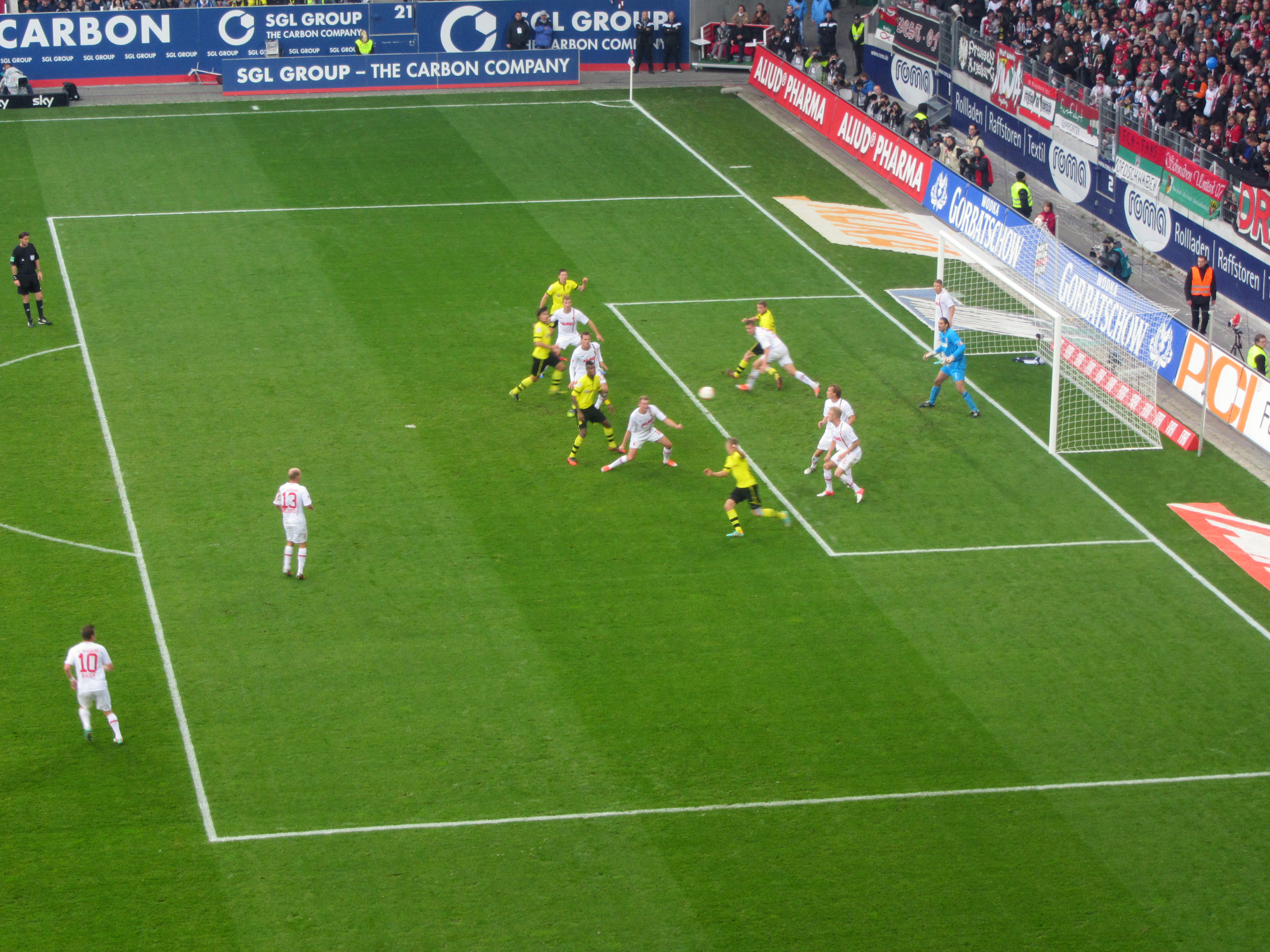
The first Bundesliga match, a 2–2 draw with SC Freiburg in August 2011, brought Sascha Mölders' first Bundesliga goal for the club; the first win came at Mainz in October. Survival under Luhukay was followed by his resignation days after safety was secured. Under Markus Weinzierl came the great arc: nine points at Christmas 2012, survival on the final day, eighth place, then fifth in 2014–15 — the club's best-ever finish — and Europe. The 2015–16 Europa League brought the "Miracle of Belgrade", a 3–1 win at Partizan that carried FCA through the group, and a round-of-32 tie with Liverpool lost by a single goal, 0–0 at home and 0–1 at Anfield. Captain Daniel Baier retired in 2020 with 274 Bundesliga appearances — the club record at his retirement — 324 league appearances in all divisions and 355 in all competitions. The spring of 2019 produced both record results, in Bundesliga scope: the biggest win, 6–0 at home to Stuttgart on 20 April 2019 (equalled by a 6–0 at Darmstadt in March 2024), and the heaviest defeat, 1–8 at VfL Wolfsburg on 18 May 2019. Coaches came and went — Dirk Schuster, Manuel Baum, Martin Schmidt, Heiko Herrlich, Weinzierl again, Enrico Maaßen, Jess Thorup, under whom Finn Dahmen kept goal for 683 minutes without conceding, a club record, in a 2024–25 season that included a Pokal quarter-final. Alfred Finnbogason's 37 Bundesliga goals stood as the club record at the end of 2025–26, with Michael Gregoritsch on 35 and Ermedin Demirović's 15 in 2023–24 the single-season record. In 2025–26 Sandro Wagner was dismissed on 1 December 2025 and Manuel Baum took over and completed the season: a 2–1 win at Bayern Munich on matchday 19 — Bayern's only league defeat of the season — a Pokal second-round exit at home to Bochum, and a final-day 0–4 defeat at Union Berlin closed a 9th-place finish with 43 points (12 wins, 7 draws, 15 defeats; 45:61 goals), the club's first top-half finish in eleven years. The club counted 30,660 members in late November 2025 — a figure equal, by a neat coincidence, to the WWK Arena's capacity.
Honours
| Competition | Success | Notes |
|---|---|---|
| Major trophies | None | FC Augsburg have never won a major trophy; the honours below are titles and best finishes |
| Bundesliga | Best finish: 5th (2014–15) | First promoted in 2011; in the top flight continuously since |
| DFB-Pokal | Semi-finalists 2009–10 | Lost 0–2 at Werder Bremen; quarter-finalists again in 2024–25 |
| Regionalliga Süd | Champions 1973–74 and 2005–06 | 1973–74 was the second tier; 2005–06 the third tier — the same competition name at different levels |
| 2. Bundesliga | Runners-up 2010–11 | Never champions of the second tier; promotion won as runners-up |
| German Under-19 championship | Winners 1993 | A youth title — the club's only national title at any level |
Timeline
- 1907 — 8 August: FC Alemannia Augsburg founded on the day of the Hoher Friedensfest — the founding date the modern FCA carries.
- 1909 — 11 May: Alemannia joins TV Oberhausen as its football section.
- 1919 — The footballers take the name Ballspiel-Club Augsburg (BC Augsburg).
- 1921 — 30 August: BCA becomes independent of the gymnastics club.
- 1934 — BCA promoted to the Gauliga Bayern, the top flight.
- 1939–40 — BCA finish Gauliga Bayern runners-up behind 1. FC Nürnberg — their best pre-war finish.
- 1945 — BCA and TSV Schwaben are founder members of the Oberliga Süd.
- 1951 — 16 September: the Rosenaustadion opens.
- 1952 — 9 November: West Germany beat Switzerland 5–1 at the Rosenaustadion before almost 65,000 — the "Augsburger Elf".
- 1957 — BC Augsburg's Helmut Haller breaks into the first team (West Germany debut follows in 1958).
- 1962 — Haller leaves BCA for Bologna — one of the first Germans to star in Italy.
- 1963 — The Bundesliga is founded without an Augsburg club; BCA start in the Regionalliga Süd.
- 1969 — 15 July: BCA merges with TSV Schwaben's licensed players' department to form FC Augsburg 1907. 30 July: FCA's first match, a 0–3 (a.e.t.) DFB-Pokal defeat to 1. FC Nürnberg.
- 1972–73 — Bayernliga champions; promoted to the Regionalliga Süd.
- 1973 — Helmut Haller returns from Juventus after eleven years in Italy.
- 1973–74 — Regionalliga Süd champions as a newly promoted side; 42,000 pack the Rosenaustadion for the Nürnberg match; the 1860 away game sets the second-division crowd record.
- 1974 — May–June: the promotion round — FCA finish second in their group, one point behind Tennis Borussia Berlin, and miss the Bundesliga.
- 1979 — Relegated from the 2. Bundesliga; Haller retires.
- 1979–80 — Bayernliga champions and German amateur championship runners-up.
- 1982 — Promoted again via the play-offs while the tax office processes the Homburg gate receipts; relegated again in 1983, three goals short of survival.
- 1986–87 — The Uli Stein cup tie: FCA beat 1860 5–1 away, then lose 1–2 to HSV as Stein is sent off for his gesture to the crowd.
- 1989 — February–October: Helmut Haller coaches FCA.
- 1992–93 — The A-Junioren win the German U19 championship (3–1 v Kaiserslautern) — the club's only national title, a youth title.
- 2000 — The DFB refuses FCA a Regionalliga licence after sponsor Infomatec's collapse; relegated to the fourth-tier Bayernliga. Walther Seinsch takes over and rebuilds.
- 2005 — 4 June: the Regensburg heartbreak — 1–0 up in the final minutes, FCA lose 1–2 and miss promotion.
- 2005–06 — Regionalliga Süd champions — back in the 2. Bundesliga after 23 years.
- 2009 — 26 July: the new arena (as the impuls arena) opens with a 2–0 win over a Schwaben select side.
- 2009–10 — First DFB-Pokal semi-final (lost 0–2 at Werder Bremen); the promotion play-off against Nürnberg is lost.
- 2011 — 8 May: Stephan Hain's 85th-minute winner against FSV Frankfurt seals promotion to the Bundesliga for the first time. 6 August: first Bundesliga match — 2–2 v SC Freiburg, Sascha Mölders scores the club's first Bundesliga goal. 15 October: first Bundesliga win, 1–0 at Mainz 05.
- 2012–13 — Nine points at the winter break; survival sealed on the final day (3–1 v Greuther Fürth).
- 2014–15 — Fifth place — the club's best-ever finish; Europa League qualification.
- 2015 — 10 December: the Miracle of Belgrade — a 3–1 win at Partizan takes FCA into the Europa League knockout stage.
- 2016 — February: Europa League round of 32 — 0–0 at home, 0–1 at Anfield; out to Liverpool by a single goal.
- 2019 — 20 April: record Bundesliga win, 6–0 v VfB Stuttgart. 18 May: record Bundesliga defeat, 1–8 at VfL Wolfsburg on the final day.
- 2020 — Captain Daniel Baier retires with 274 Bundesliga appearances — the club record.
- 2021 — 3 April: the 100th Bundesliga win (2–1 v Hoffenheim).
- 2024 — 2 March: the away record win equalled, 6–0 at Darmstadt 98.
- 2024–25 — Finn Dahmen's 683 minutes without conceding — a club record; DFB-Pokal quarter-final.
- 2025 — 25 October: record home defeat, 0–6 v RB Leipzig. 1 December: Sandro Wagner dismissed; Manuel Baum takes over and leads FCA to the closing point.
- 2026 — May: the 2025–26 season ends with FCA 9th — the article's closing point.
References
- FC Augsburg — club history, honours and records, cross-checked between the English and German reference records of the club, the club's official site, bundesliga.com and the DFB data centre (Baier's appearance records, Finnbogason's 37 Bundesliga goals and the WWK Arena capacity of 30,660 as scoped and dated in the text).
- The settlement of the heaviest Bundesliga defeat (1–8 at VfL Wolfsburg, 18 May 2019) follows the published Yavex history of VfL Wolfsburg; the 1973–74 promotion-round outcome (one point behind Tennis Borussia Berlin) follows the DFB's settled results for the round.
Image source: Wikimedia Commons.


