 YAVE
FC Barcelona
The Blaugrana Story — Gamper, Cruyff, the Dream Team, Messi and the Sextuple

Futbol Club Barcelona were founded on 29 November 1899 by the Swiss-born Joan Gamper, who had placed an advertisement in the magazine Los Deportes inviting players to form a team. Owned and operated by their members, the socis, and playing under the motto "Més que un club" — More than a club — Barcelona have played at Camp Nou since it opened on 24 September 1957. Before redevelopment it held 99,354, the largest capacity in Europe. Renovation under the Espai Barça project began on 1 June 2023; the team played the 2023–24 and 2024–25 seasons at the Estadi Olímpic Lluís Companys in Montjuïc, and returned to the renamed Spotify Camp Nou on 22 November 2025 with a reduced capacity (62,652 during the phased return) while work continues. The completed stadium is expected to hold about 105,000, with completion aimed for 2027.
Barcelona are one of only three founding members of the Primera División — with Athletic Bilbao and Real Madrid — never to have been relegated from the top flight since the league began in 1929. They have won 29 La Liga titles and a record 32 Copas del Rey, and five European Cups. Lionel Messi is Barcelona's all-time top scorer with 672 goals in official competitions, scored between 2004 and 2021 — the most goals any player has scored for a single club — and he also holds the club appearance record with 778 official appearances in all competitions.
Contents
- Gamper's Foundation and the First Golden Age (1899–1929)
- Republic, Civil War and the Kubala Revival (1929–1957)
- Camp Nou, Lean Decades and Cruyff the Player (1957–1988)
- The Dream Team and the Transition (1988–2003)
- Rijkaard, Guardiola and the Messi Era (2003–2021)
- Laporta's Return: Reset, Exile and the Flick Rebuild (2021–2026)
- Honours
- Timeline
- References
Gamper's Foundation and the First Golden Age (1899–1929)

Eleven founders attended Gamper's meeting at the Gimnasio Solé, and Walter Wild became the first president; Gamper himself would serve as president five times between 1908 and 1925. The club's first trophy was the Copa Macaya in 1902. Barcelona dominated the Catalan championship in the Gamper era and won early Copas del Rey in 1910, 1912, 1913, 1920, 1922, 1925, 1926 and 1928, with stars such as Paulino Alcántara, Ricardo Zamora and Josep Samitier. The club moved to the Camp de Les Corts in 1922, and in 1929 Barcelona won the inaugural La Liga.
Republic, Civil War and the Kubala Revival (1929–1957)
The decades that followed brought decline amid political conflict. Gamper died in 1930; president Josep Sunyol was killed by Falangist soldiers in August 1936, during the Civil War, and under Franco the club was forced to Castilianise its name. Post-war league titles came in 1945, 1948 and 1949, and the signing of the Hungarian László Kubala in 1950 transformed the side: the "Barça of the Five Cups" won five trophies in 1952. The Kubala era made the old ground too small, and the Camp Nou project was launched — the new stadium opened in 1957.
Camp Nou, Lean Decades and Cruyff the Player (1957–1988)
Helenio Herrera's side won league titles in 1959 and 1960, but the 1961 European Cup final was lost 3–2 to Benfica in Bern, and a long league drought followed under Real Madrid's dominance. In 1973 Johan Cruyff signed from Ajax for a then world-record fee of £920,000 and inspired the 1973–74 league title — the club's first since 1960 — including a famous 5–0 win at the Santiago Bernabéu; he won the Ballon d'Or in 1973 and 1974 as a Barcelona player. The first Cup Winners' Cup arrived in 1979, the year the La Masia farmhouse became the academy residence. Diego Maradona's spell (1982–84) was brief and turbulent; Terry Venables won the league in 1985, but the 1986 European Cup final was lost on penalties to Steaua București.
The Dream Team and the Transition (1988–2003)
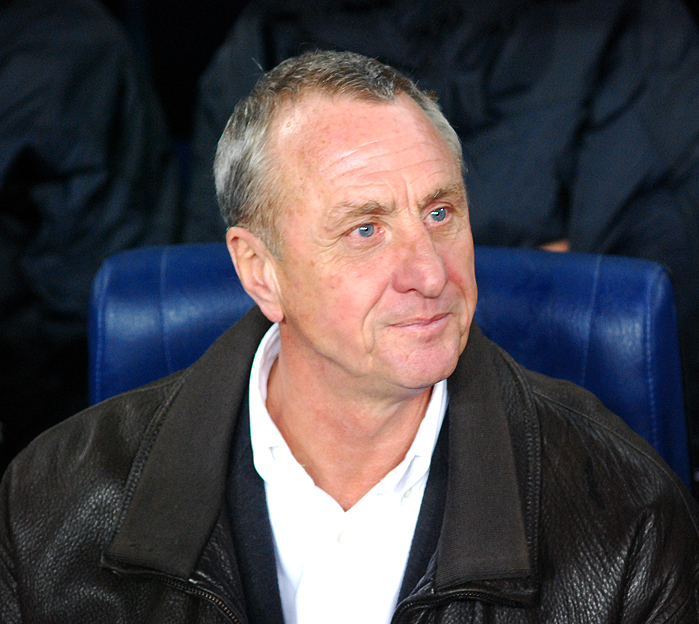
Cruyff returned as coach in 1988 and built the "Dream Team" on La Masia graduates such as Pep Guardiola alongside Ronald Koeman, Michael Laudrup, Romário and Hristo Stoichkov. His side won four consecutive La Liga titles (1990–91 to 1993–94) and, at Wembley in 1992, the club's first European Cup, Koeman's free-kick beating Sampdoria 1–0 after extra time; with the 1989 Cup Winners' Cup, the 1990 Copa del Rey and the 1992 European Super Cup, Cruyff collected 11 trophies in eight years. After him, Bobby Robson's side won a cup treble in 1996–97 built around Ronaldo, and Louis van Gaal delivered the 1998 double and the 1999 centenary title. Then came decline under president Joan Gaspart (2000–03), darkened by Luís Figo's defection to Real Madrid.
Rijkaard, Guardiola and the Messi Era (2003–2021)

Joan Laporta's presidency and Frank Rijkaard rebuilt the side around Ronaldinho: league titles in 2005 and 2006 and a second European Cup, 2–1 against Arsenal in Paris. In 2008 Guardiola, a La Masia graduate and Dream Team midfielder, took over and imposed the tiki-taka style around Xavi Hernández, Andrés Iniesta and Messi, who had made his official debut in October 2004. The 2008–09 side won the first treble by a Spanish club — La Liga, the Copa del Rey and the Champions League in Rome — and in calendar year 2009 Barcelona won all six competitions they entered: La Liga, the Copa del Rey, the Champions League, the Supercopa de España, the UEFA Super Cup and the FIFA Club World Cup — the first European club ever to win six trophies in a single year. A second Champions League followed at Wembley in 2011, and Guardiola left in 2012 with 14 trophies in four seasons. Tito Vilanova's team won a 100-point league title in 2013, and Luis Enrique's Messi–Suárez–Neymar side won a second treble in 2015, beating Juventus 3–1 in Berlin; the 6–1 comeback against Paris Saint-Germain in 2017, from 0–4 down, was another landmark. But the late Bartomeu years drifted, and in August 2021 the club disclosed debts of €1.35 billion and a wage bill equal to 103% of income; although a new contract had been agreed with Messi, it could not be registered under La Liga's salary-cap rules, and he left for Paris Saint-Germain after 21 years at the club.
Laporta's Return: Reset, Exile and the Flick Rebuild (2021–2026)

Laporta had returned as president in March 2021, after Josep Maria Bartomeu's resignation the previous October. In the summer of 2022, with the approval of the members' assembly, the club activated a series of asset sales widely known as the "economic levers" (palancas): it sold 25% of its La Liga television rights for the next 25 years to the investment firm Sixth Street (in two tranches of 10% and 15%), and 49% of Barça Studios — 24.5% each to Socios.com and Orpheus Media, for €100 million each. The income allowed the club to comply with La Liga's salary cap and register signings including Robert Lewandowski, Raphinha and Jules Koundé. Xavi Hernández, coach from November 2021, won La Liga in 2022–23. The Espai Barça works closed Camp Nou in June 2023 and the team spent two seasons in exile at Montjuïc. Hansi Flick, appointed on 29 May 2024, won a domestic treble in 2024–25 — the 28th La Liga, the 32nd Copa del Rey and the Supercopa — and the team returned to Spotify Camp Nou on 22 November 2025. The completed 2025–26 season brought a 16th Supercopa in January 2026 and a 29th La Liga title, clinched on 10 May 2026 with a 2–0 home Clásico win over Real Madrid.
Honours
| Competition | Titles | Years / notes |
|---|---|---|
| La Liga | 29 | 1929, 1944–45, 1947–48, 1948–49, 1951–52, 1952–53, 1958–59, 1959–60, 1973–74, 1984–85, 1990–91, 1991–92, 1992–93, 1993–94, 1997–98, 1998–99, 2004–05, 2005–06, 2008–09, 2009–10, 2010–11, 2012–13, 2014–15, 2015–16, 2017–18, 2018–19, 2022–23, 2024–25, 2025–26 |
| Copa del Rey | 32 (record) | 1910, 1912, 1913, 1920, 1922, 1925, 1926, 1928, 1942, 1951, 1952, 1953, 1957, 1959, 1963, 1968, 1971, 1978, 1981, 1983, 1988, 1990, 1997, 1998, 2009, 2012, 2015, 2016, 2017, 2018, 2021, 2025 |
| Supercopa de España | 16 (record) | 1983, 1991, 1992, 1994, 1996, 2005, 2006, 2009, 2010, 2011, 2013, 2016, 2018, 2023, 2025, 2026 |
| Copa de la Liga | 2 (record) | 1983, 1986 |
| Copa Eva Duarte | 3 (record) | 1948, 1952, 1953 |
| European Cup / UEFA Champions League | 5 | 1991–92, 2005–06, 2008–09, 2010–11, 2014–15 |
| UEFA Cup Winners' Cup | 4 (record) | 1978–79, 1981–82, 1988–89, 1996–97 |
| UEFA Super Cup | 5 | 1992, 1997, 2009, 2011, 2015 |
| Inter-Cities Fairs Cup | 3 (record) | 1955–58, 1958–60, 1965–66 |
| Latin Cup | 2 (joint record) | 1949, 1952 |
| FIFA Club World Cup | 3 | 2009, 2011, 2015 |
Timeline
- 1899 — Joan Gamper founds Foot-Ball Club Barcelona (29 November).
- 1902 — First trophy: the Copa Macaya.
- 1909 — Move to Camp de la Indústria; the crest competition produces the badge still used today.
- 1922 — Les Corts stadium opens.
- 1929 — Barcelona win the first-ever La Liga.
- 1930 — Founder Joan Gamper dies (30 July).
- 1936 — President Josep Sunyol is killed by Falangist soldiers during the Civil War.
- 1950 — László Kubala signs; the great 1950s side is built around him.
- 1952 — The "Barça of the Five Cups" wins five trophies in one year.
- 1957 — Camp Nou opens (24 September).
- 1961 — First European Cup final; lost 3–2 to Benfica in Bern.
- 1973 — Johan Cruyff signs from Ajax for a world-record fee.
- 1974 — Cruyff inspires the first league title in 14 years, including a 5–0 win at the Bernabéu.
- 1979 — First European trophy of the modern era: the Cup Winners' Cup in Basel; La Masia becomes the academy residence.
- 1988 — Cruyff returns as coach and builds the Dream Team.
- 1992 — First European Cup: Koeman's free-kick beats Sampdoria at Wembley (20 May).
- 2004 — Lionel Messi makes his official first-team debut (October, v Espanyol).
- 2006 — Second European Cup: 2–1 v Arsenal in Paris under Frank Rijkaard.
- 2009 — Guardiola's side wins the treble, then completes the six-trophy calendar year.
- 2011 — Fourth European Cup at Wembley (3–1 v Manchester United); Messi, Iniesta and Xavi had swept the 2010 Ballon d'Or podium.
- 2012 — Guardiola leaves with 14 trophies; Messi scores 91 goals in the calendar year.
- 2015 — Second treble under Luis Enrique (Berlin, 3–1 v Juventus).
- 2017 — La Remontada: 6–1 v Paris Saint-Germain after losing the first leg 4–0.
- 2021 — Laporta returns; €1.35bn debt disclosed; Messi leaves for PSG (August).
- 2022 — The "economic levers" are activated; Lewandowski, Raphinha and Koundé sign.
- 2023 — Xavi's side wins the 27th La Liga; Camp Nou closes for redevelopment (June) and the team moves to Montjuïc.
- 2024 — Hansi Flick appointed head coach (29 May).
- 2025 — Domestic treble under Flick: 28th La Liga, 32nd Copa del Rey, Supercopa. The team returns to Spotify Camp Nou on 22 November.
- 2026 — 16th Supercopa (January) and the 29th La Liga title, clinched by beating Real Madrid 2–0 at Camp Nou on 10 May.
References
- Wikipedia — "FC Barcelona", "Camp Nou", "List of FC Barcelona records and statistics".
- FC Barcelona (fcbarcelona.com) — official honours list; official Lionel Messi profile; match reports (26 April 2025; 10 May 2026).
- ESPN; Sports Illustrated — reports of the 2025–26 La Liga title (May 2026).
- Wikimedia Commons — file pages for the photographs used.
Image source: Wikimedia Commons.


