 YAVE
Fulham
The history of Fulham: the Cottagers, Johnny Haynes and the road to Hamburg

Fulham were founded in September 1879 as Fulham St Andrew's Church Sunday School F.C., by worshippers at St Andrew's Church on Star Road, West Kensington — and they are London's oldest professional football club. The Cottagers — also known, from their white shirts, as the Whites — have played at Craven Cottage, on the banks of the Thames, since 1896, in a ground of just over 28,000 whose landmarks are the cottage pavilion in the corner and the Grade II-listed Johnny Haynes Stand.
Fulham have never won a major trophy. What they have instead is a story of near-misses and one unforgettable European spring: FA Cup finalists in 1975, and in 2010 Europa League finalists, beaten by Atlético Madrid in extra time after a run that conquered Juventus and Hamburg. The records belong to two favourites: Gordon Davies, the club's top scorer with 178 goals, and Johnny Haynes — "the Maestro" — whose 658 appearances (some sources give 657) made him the face of the club, and who in 1961 became football's first £100-a-week player.
Contents
- A Church Sunday School Team and the Southern League (1879–1907)
- League Life and a First Second Division Title (1907–1949)
- The Johnny Haynes Era (1949–1970)
- The 1975 Final, the Cameo Years and the Fight to Exist (1970–1997)
- Al-Fayed, the Premier League and the Road to Hamburg (1997–2013)
- The Khan Yo-Yo Years and the Silva Consolidation (2013–present)
- Honours
- Timeline
- References
A Church Sunday School Team and the Southern League (1879–1907)

The church team — its mother church still stands, with a plaque commemorating the foundation — shortened its name to Fulham in December 1888, and won the West London Amateur Cup in 1887 and the West London League in 1893. The club bought the Craven Cottage site in 1894 but had to wait two years to play there: Fulham moved in during 1896, the first game against the now-defunct Minerva, and adopted the white-shirt, black-shorts identity they have kept ever since. Professional status followed on 12 December 1898 — Fulham were the third London club to turn professional, after Arsenal and Millwall — along with admission to the Southern League. Southern League Second Division titles came in 1901–02 and 1902–03, then the big prize twice: Southern League First Division champions in 1905–06 and 1906–07. After the second triumph, Fulham were elected to the Football League in 1907 — the church team was now a League club.
League Life and a First Second Division Title (1907–1949)
Fulham's first League game was a 1–0 home defeat by Hull City in September 1907; they finished fourth, three points short of promotion, and reached the 1908 FA Cup semi-final — where the 6–0 defeat by Newcastle United remains a record loss for an FA Cup semi-final. Chairman Henry Norris's thread runs into local history: he rejected Gus Mears's offer to move Fulham to the Stamford Bridge site, so Mears founded Chelsea there instead. Relegated to the Third Division South in 1928, Fulham were champions in 1931–32 with 111 goals, including a 10–2 win over Torquay United, and on 8 October 1938 the Cottage recorded its record crowd — 49,335 against Millwall. War interrupted league football, but in the third post-war season, 1948–49, Fulham won the Second Division — top-flight football for the first time.
The Johnny Haynes Era (1949–1970)

The first First Division spell lasted three seasons. The era's defining figure had already arrived: Johnny Haynes, signed as a schoolboy in 1950, debuted on Boxing Day 1951 and stayed for 18 years — a one-club career as the team's creative heart, scoring 158 goals. FA Cup semi-finalists in 1958, beaten in a replay by Manchester United's post-Munich side, Fulham were promoted back to the First Division in 1958–59 as runners-up under player-turned-manager Bedford Jezzard, with Graham Leggat joining Haynes in attack; tenth place in 1959–60 was the club's best league finish for over 40 years. In 1961, after the maximum wage was abolished, Haynes became football's first £100-a-week player — and stayed loyal despite Italian interest, captaining England (56 caps, 22 as captain) while a Second Division player for much of his career. Alongside him, right-back George Cohen made 459 appearances and won the 1966 World Cup with England as vice-captain. The 1965–66 "Great Escape" — bottom in late February, nine wins in the last 13 games — only delayed the fall: relegation in 1968, in a year when Bobby Robson's brief managerial spell came and went, and a second straight relegation in 1969. Haynes's last game came in January 1970.
The 1975 Final, the Cameo Years and the Fight to Exist (1970–1997)
Straight back up as Third Division runners-up in 1970–71, Fulham then built the glamorous side of Alec Stock, who signed two former England captains — Alan Mullery and Bobby Moore — and in 1975 reached the club's only FA Cup final, losing 2–0 to Moore's old club West Ham United at Wembley, both goals by Alan Taylor. The cameo years peaked in 1976–77, when George Best played 47 games for Fulham and Rodney Marsh returned briefly — glamour in the Second Division, but no promotion. Malcolm Macdonald's young side won promotion in 1982 behind Gordon Davies, who across two spells became the club's record scorer with 178 goals — but the promising team was sold off amid debt, and Fulham were relegated to the Third Division in 1986. In February 1987 came near-extinction: property company Marler Estates announced a merger with Queens Park Rangers — the merged club to be called "Fulham Park Rangers", playing at Loftus Road while Craven Cottage was sold for housing. Furious supporters of both clubs, backed publicly by ex-player Jimmy Hill, killed the plan, and a Hill-fronted consortium saved the club. The reprieve was not a revival: relegated to the fourth tier in 1994, Fulham hit their lowest-ever finish, 17th in the fourth tier in 1995–96, before Micky Adams took them up as runners-up in 1996–97 — the platform for a takeover.
Al-Fayed, the Premier League and the Road to Hamburg (1997–2013)
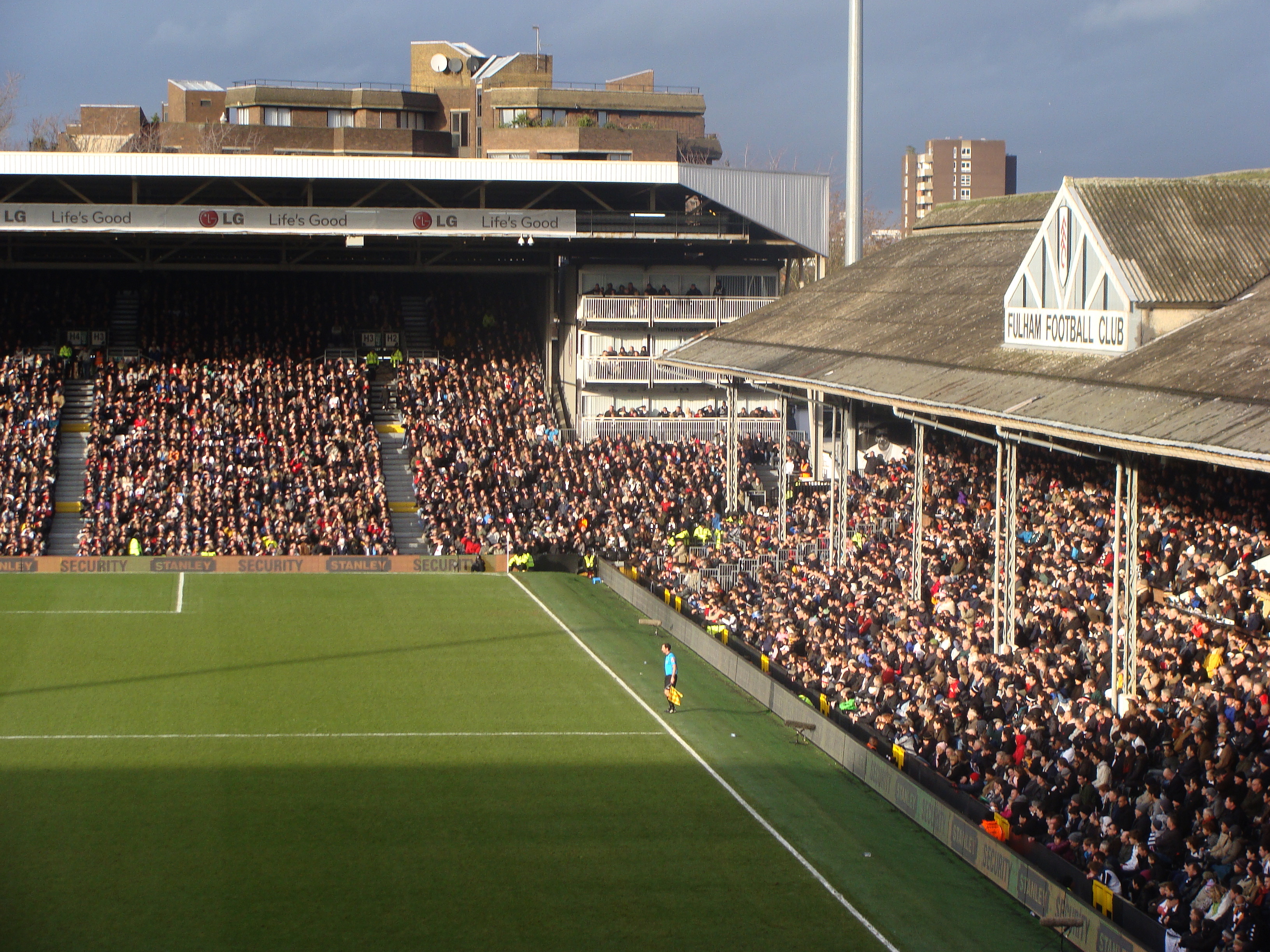
Mohamed Al-Fayed bought Fulham in the summer of 1997, pledging the Premier League within five years. Kevin Keegan's side won Division Two in 1998–99 with 101 points; Jean Tigana's side won Division One in 2000–01, again with 101 points — top-flight football for the first time since 1968. The Cottage had to become all-seater, so Fulham groundshared at Loftus Road in 2002–04 while it was rebuilt, amid fears they might never return. In Europe for the first time, Fulham won the 2002 UEFA Intertoto Cup — one of the competition's three winning clubs that year — beating Bologna in the final, and reached the UEFA Cup third round. Chris Coleman's ninth place in 2003–04 was a club record, but by December 2007 Fulham were in the relegation zone. Roy Hodgson arrived on 28 December 2007 and produced the "Great Escape": still facing relegation at half-time of the third-to-last game, 2–0 down at Manchester City, Fulham won 3–2 and survived on the final day. Hodgson then delivered the club's greatest seasons: seventh in 2008–09, the highest-ever finish, and the 2009–10 Europa League run — holders Shakhtar Donetsk beaten, Juventus beaten 4–1 at the Cottage, Wolfsburg and Hamburg beaten in the quarter- and semi-finals — before the final in Hamburg on 12 May 2010, where Simon Davies cancelled out Diego Forlán's opener but Forlán scored again in the 116th minute: Atlético Madrid 2–1 Fulham, after extra time.
The Khan Yo-Yo Years and the Silva Consolidation (2013–present)

Shahid Khan bought the club on 12 July 2013. The first season of his ownership ended the 13-year top-flight run: Martin Jol, René Meulensteen and Felix Magath all failed, and Fulham were relegated in May 2014. Slaviša Jokanović rebuilt and took Fulham to the 2018 play-off final — Aston Villa beaten 1–0 at Wembley — but relegation followed within a season; Scott Parker then won the 2020 play-off final against Brentford, and relegation followed again. Fulham changed divisions in five successive seasons. Parker left, and Marco Silva arrived in 2021: the 2021–22 Championship title, powered by Aleksandar Mitrović's record 43 league goals, finally broke the cycle. Since 2022 Fulham have been a settled Premier League club under Silva — reaching a first EFL Cup semi-final in 2023–24 — while the new Riverside Stand was completed at the Cottage, lifting the ground's capacity to just over 28,000. London's oldest professional club, nearly merged out of existence in 1987, is now a fixture of the top flight.
Honours
| Trophy | Titles | Years |
|---|---|---|
| League title (First Division / Premier League) | 0 | Never won — best finish 7th, 2008–09 |
| FA Cup | 0 | Never won — runners-up 1974–75 |
| League Cup | 0 | Never won — best run semi-final, 2023–24 |
| UEFA Europa League | 0 | Runners-up 2009–10 |
| UEFA Intertoto Cup | 1 | 2002 (one of three winning clubs) |
| Second Division / Division One / Championship (second tier) | 3 | 1948–49, 2000–01, 2021–22 |
| Third Division South / Division Two (third tier) | 2 | 1931–32, 1998–99 |
Timeline
- 1879 — Fulham St Andrew's Church Sunday School F.C. are formed by worshippers at St Andrew's Church, West Kensington — the future London's oldest professional football club; the name is shortened to Fulham in 1888.
- 1896 — Fulham move into Craven Cottage (bought 1894, first game vs Minerva) and adopt the white-shirt / black-shorts identity; the ground is still home today.
- 1898–1907 — Professional status (12 December 1898), Southern League titles in 1905–06 and 1906–07, and election to the Football League in 1907.
- 1938 — Craven Cottage's record crowd: 49,335 watch the Millwall match on 8 October.
- 1949 — Second Division champions (1948–49): Fulham reach the First Division for the first time.
- 1959–1961 — Promoted back to the First Division in 1959 with Johnny Haynes as captain and star; in 1961 Haynes becomes the first £100-a-week footballer after the maximum wage is abolished. George Cohen, his team-mate, wins the World Cup with England in 1966.
- 1975 — Fulham's only FA Cup final: Bobby Moore and Alan Mullery's Second Division side lose 2–0 to West Ham United at Wembley.
- 1987 — The "Fulham Park Rangers" merger with QPR is announced by Marler Estates — and defeated by supporters of both clubs and a Jimmy Hill-led consortium, which saves Fulham as Fulham FC (1987) Ltd.
- 1999–2001 — Mohamed Al-Fayed's Fulham win two titles in three seasons with 101 points each: Division Two under Kevin Keegan (1999), then Division One under Jean Tigana (2001) — back in the top flight after 33 years.
- 2002 — UEFA Intertoto Cup winners (Bologna beaten 5–3 on aggregate) in Fulham's first European campaign; the club groundshares at Loftus Road in 2002–04 while the Cottage is rebuilt.
- 2008–2010 — Roy Hodgson's "Great Escape" keeps Fulham up in 2008; 7th place in 2009 is the club's highest-ever finish; in 2010 Fulham beat Shakhtar, Juventus, Wolfsburg and Hamburg to reach the Europa League final, losing 2–1 to Atlético Madrid after extra time in Hamburg.
- 2014–2022 — Under Shahid Khan (owner from July 2013) Fulham are relegated in 2014, then yo-yo: play-off wins in 2018 (Aston Villa) and 2020 (Brentford) are each followed by relegation, until Marco Silva's side win the 2021–22 Championship title and establish the club in the Premier League from 2022.
References
- Wikipedia — "Fulham F.C." (history, honours and records).
- Wikipedia — "List of Fulham F.C. records and statistics" and "List of Fulham F.C. players".
- Fulham FC — fulhamfc.com, "Fulham's Greatest Scorer: Davies" (Gordon Davies, 178 goals).
- UEFA.com — Johnny Haynes obituary and the 2010 Europa League final; FourFourTwo — the 2010 final retrospective.
- Wikimedia Commons — file pages for the photographs used.
Image source: Wikimedia Commons.


