 YAVE
Las Palmas
Los Amarillos — the Golden Age, the Cantera and the Epic Away-Goals Promotion

Unión Deportiva Las Palmas — Los Amarillos, the Yellows — are the club of Las Palmas de Gran Canaria in the Canary Islands, famous across Spanish football for their cantera, an academy built on local, technical, ball-playing talent. Las Palmas were founded on 22 August 1949 at the Real Club Náutico, when the city's five clubs — Real Club Victoria, Marino FC, CD Gran Canaria, Atlético Club and Arenas Club — unanimously agreed to merge into one strong club, a merger proposed by Manuel Rodríguez Monroy so that Canarian players would no longer have to leave for the mainland; the RFEF had accepted Canarian football into the national third tier on 6 June 1949. The club's first president was José del Río Amor. Their home since 2003 is the Estadio Gran Canaria, opened on 8 May 2003, with a capacity of 32,400.
Las Palmas have never won La Liga or the Copa del Rey, but they were league runners-up in 1968–69 — still the club's best-ever finish — and cup finalists in 1978. David García holds the club record with 474 appearances in official matches (2003–2019); he passed Germán Dévora's mark of 453 on 25 August 2018. Germán Dévora, the club's all-time top scorer in all competitions with 119 goals (84 of them in the top flight), remains the emblem of the golden age.
Contents
- A Merger, and Straight to the Top (1949–1960)
- The Golden Age (1960–1970)
- The Argentine Era and the Cup Final (1970–1983)
- Decline, Crisis and a Brief Return (1983–2002)
- The Wilderness and the Epic Return (2002–2015)
- Setién, Pimienta and the Yo-Yo (2015–2025)
- Honours
- Timeline
- References
A Merger, and Straight to the Top (1949–1960)
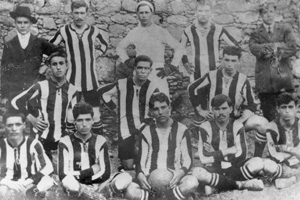
Las Palmas played their first match on 9 October 1949 at the Estadio Las Palmas — the ground opened on Christmas Day 1944 for Marino FC, renamed and expanded to 22,000 as the Estadio Insular in 1951. The new club achieved something unique in Spanish football: back-to-back promotions in its first two seasons, reaching the Primera División in 1951, where the debut match was a 4–1 home defeat by Real Madrid on 9 September 1951. Relegated after one season, Las Palmas won the Segunda División in 1953–54 and stayed in the top flight for six seasons before going down again in 1960.
The Golden Age (1960–1970)

Segunda champions again in 1963–64, Las Palmas began a run of 19 consecutive seasons in the top flight. The heart of the side was the generation nicknamed los Diablillos Amarillos — the Little Yellow Devils — the club's Spanish youth championship-winning team of 1962, coached by Luis Molowny: Germán Dévora, Tonono, Juan Guedes, Paco Castellano, Martín Marrero and José Manuel León, almost all Canarian academy products. Under Molowny, Las Palmas finished third in 1967–68, four points off the title and the division's top scorers, and in 1968–69 they were La Liga runners-up — the club's best-ever finish. A European debut followed in the 1969–70 Inter-Cities Fairs Cup, lost in the first round to Hertha BSC.
The Argentine Era and the Cup Final (1970–1983)

The golden generation was touched by tragedy: Juan Guedes died suddenly in March 1971, aged 28, and Tonono died in 1975. On the pitch there was a fifth place under Pierre Sinibaldi in 1971–72 and a UEFA Cup run the following season past Torino and Slovan Bratislava before FC Twente ended it in the third round. In the mid-1970s an Argentine contingent arrived — goalkeeper Daniel Carnevali, Miguel Ángel Brindisi, Carlos Morete and Quique Wolff — and under Miguel Muñoz Las Palmas finished fourth in 1976–77 and reached their only Copa del Rey final, losing 3–1 to FC Barcelona at the Santiago Bernabéu on 19 April 1978. A UEFA Cup tie lost to Ipswich Town came the same season. The 19-year top-flight run finally ended with relegation in 1983.
Decline, Crisis and a Brief Return (1983–2002)
Las Palmas were Segunda champions in 1984–85, but relegated from the Primera in 1988, finishing 20th — the club's worst top-flight season — and in 1992 they fell into Segunda División B amid a financial crisis that nearly killed the club. Segunda B titles in 1992–93 and 1995–96 and a Copa del Rey semi-final in 1997 steadied things, and under Sergije Krešić the Segunda title of 1999–2000 brought two seasons back in La Liga. They were lit by academy product Rubén Castro, who scored twice in a 4–2 home win over Real Madrid in October 2001, before relegation in 2002 closed the era.
The Wilderness and the Epic Return (2002–2015)
The club moved to the new Estadio Gran Canaria in 2003 but was relegated to Segunda B in 2004, returning to the Segunda in 2006 for years of second-tier struggle. In the 2013–14 promotion play-off final against Córdoba, Las Palmas were seconds from promotion when Córdoba equalised deep in stoppage time of the second leg and went up instead. A year later came redemption: coached by Paco Herrera and led by Sergio Araujo's 25 goals, Las Palmas won both play-off ties on the away-goals rule — past Valladolid, then the final against Real Zaragoza, losing 3–1 in Zaragoza but winning 2–0 at home on 21 June 2015, Roque Mesa scoring before Araujo's volley five minutes from time. A 13-year absence from La Liga was over, and 40-year-old academy icon Juan Carlos Valerón was in the squad for a farewell top-flight season.
Setién, Pimienta and the Yo-Yo (2015–2025)

Quique Setién's possession side drew wide praise in finishing 11th in 2015–16, but after three La Liga seasons Las Palmas were relegated in 2018. Five Segunda seasons followed — including a 2022 play-off semi-final lost to Tenerife — before García Pimienta's team, built on the division's best defence, finished second in 2022–23 and sealed promotion with a 0–0 draw against Alavés on 27 May 2023. Survival in 16th place followed in 2023–24. In 2024–25, under Diego Martínez from October, a long winless run and the absence of captain Kirian Rodríguez — who had missed most of the promotion season while recovering from Hodgkin lymphoma — from February onwards condemned the club: defeat at Sevilla on 13 May and results elsewhere confirmed relegation on 14 May 2025, Las Palmas finishing 19th with 32 points. Throughout it all the cantera kept producing — Valerón, Jonathan Viera, Vitolo, Roque Mesa, Rubén Castro, Sandro Ramírez, Yeremy Pino, Alberto Moleiro, Kirian Rodríguez and Pedri, who broke into the first team in 2019–20 before joining Barcelona.
Honours
| Competition | Titles | Years / notes |
|---|---|---|
| La Liga | 0 | Never won — runners-up 1968–69; 3rd in 1967–68 |
| Copa del Rey | 0 | Never won — runners-up 1977–78 (lost 3–1 to Barcelona); semi-finals 1974, 1984, 1997 |
| Segunda División | 4 | 1953–54, 1963–64, 1984–85, 1999–2000 |
| Segunda División B | 2 | 1992–93, 1995–96 |
| UEFA Cup / Fairs Cup | 0 | Never won — best: UEFA Cup third round 1972–73 |
Timeline
- 1944 — 25 December: the Estadio Las Palmas (later the Estadio Insular) opens, built for Marino FC.
- 1949 — 22 August: UD Las Palmas founded at the Real Club Náutico by the merger of Real Club Victoria, Marino FC, CD Gran Canaria, Atlético Club and Arenas Club; José del Río Amor first president. 9 October: first match.
- 1951 — Second consecutive promotion, to the Primera División — a unique feat in Spanish football. 9 September: top-flight debut v Real Madrid at the renamed, expanded Estadio Insular. Relegated at the season's end.
- 1954 — Segunda División champions; back in the top flight for six seasons.
- 1960 — Relegated after the club's worst season to that point.
- 1962 — The Molowny-coached youth side, los Diablillos Amarillos, win the Spanish youth championship; Germán Dévora makes his first-team debut (16 September).
- 1964 — Segunda champions again — the start of 19 consecutive top-flight seasons.
- 1968 — Third in La Liga under Luis Molowny, four points behind Real Madrid, as the division's top scorers.
- 1969 — La Liga runners-up — the club's best-ever finish. European debut follows in the Fairs Cup (lost to Hertha BSC).
- 1971 — Juan Guedes dies suddenly, aged 28 (9 March).
- 1972 — Fifth place under Pierre Sinibaldi; the next season's UEFA Cup run beats Torino and Slovan Bratislava before FC Twente end it.
- 1973 — Argentine goalkeeper Daniel Carnevali arrives, first of the Argentine contingent (Brindisi, Morete, Wolff follow).
- 1975 — Defender Tonono dies of a liver infection.
- 1978 — Copa del Rey final: lost 3–1 to Barcelona at the Bernabéu (19 April), under Miguel Muñoz. UEFA Cup tie lost to Ipswich Town the same season.
- 1983 — Relegation ends the 19-year top-flight run.
- 1985 — Segunda champions; promoted.
- 1988 — Relegated finishing 20th, the club's worst top-flight season.
- 1992 — Relegated to Segunda División B amid a financial crisis; Segunda B champions the following season.
- 1997 — Copa del Rey semi-final.
- 2000 — Segunda champions under Sergije Krešić; two seasons back in La Liga (2000–02), including a 4–2 home win over Real Madrid (October 2001).
- 2003 — Move to the Estadio Gran Canaria (opened 8 May, v Anderlecht); the Estadio Insular closes.
- 2004 — Relegated to Segunda División B; back in the Segunda in 2006.
- 2014 — Play-off final heartbreak: Córdoba's stoppage-time equaliser at the Estadio Gran Canaria denies promotion.
- 2015 — 21 June: promotion to La Liga on away goals — 2–0 v Zaragoza (Roque Mesa, Araujo) overturning a 3–1 first-leg defeat; 13 years away end.
- 2018 — Relegated from La Liga (19th) after three seasons, the first two under Quique Setién.
- 2019 — The Ciudad Deportiva at Barranco Seco opens (8 July).
- 2023 — 27 May: promoted to La Liga as Segunda runners-up under García Pimienta, sealed with a 0–0 draw v Alavés on the final day.
- 2024 — Survival in 16th place; García Pimienta departs in the summer.
- 2025 — Relegated again: 19th with 32 points under Diego Martínez; relegation confirmed on 14 May after a 1–0 defeat at Sevilla the night before.
References
- Wikipedia — "UD Las Palmas", "Estadio Gran Canaria", "Estadio Insular", "Germán Dévora", "David García (footballer, born 1982)".
- LaLiga.com — club and player features (Dévora records; the 2015 play-offs).
- FC Barcelona (fcbarcelona.com) — the 1978 Copa del Rey final and the 2015 promotion play-off.
- Football España — 2024–25 season reporting and the confirmation of relegation, 14 May 2025.
- Sports Mole; CNBC/LaLiga — the 2023 promotion.
- Tinta Amarilla — club records (Dévora, David García).
- Wikimedia Commons — file pages for the photographs used.
Image source: Wikimedia Commons.


