 YAVE
Leicester City
The history of Leicester City: from Leicester Fosse to the 5,000-1 champions and beyond

Leicester City were founded in 1884 as Leicester Fosse, a team of old boys from Wyggeston School who took their name from the Fosse Road area where they first played. When league football resumed after the First World War, Leicester Fosse had ceased trading through financial difficulties, and in 1919 the club was reformed as Leicester City — a name that fitted Leicester's recently granted city status. The Foxes, as they have been known ever since the fox appeared on the crest, played at Filbert Street for 111 years and since 2002 at the King Power Stadium, capacity 32,261.
For most of their history Leicester were a club of near-misses: league runners-up in 1929, four times FA Cup finalists without winning. Then, in the space of six modern years, they produced the most astonishing story in English football — the 5,000-1 Premier League title of 2016 — and followed it with a first FA Cup in 2021.
Contents
- Leicester Fosse: School Old Boys, Filbert Street and the Football League (1884–1919)
- Leicester City, Peter Hodge and the 1920s Near-Title (1919–1949)
- Rowley, Matt Gillies, the "Ice Kings" and the First Silverware (1949–1971)
- Bloomfield, Lineker, Play-Off Heartbreak and Martin O'Neill's Cups (1971–2000)
- Administration, League One, Pearson's Rebuild and the Great Escape (2000–2015)
- The 5000-1 Title, the FA Cup, and the Fall (2015–present)
- Honours
- Timeline
- References
Leicester Fosse: School Old Boys, Filbert Street and the Football League (1884–1919)
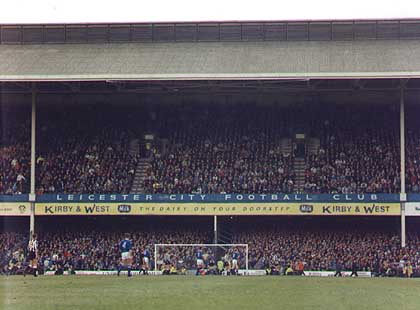
The young club joined the FA in 1890 and the Midland League in 1891, the year it moved to Filbert Street. Elected to the Football League's Second Division in 1894, Fosse's first league match was a 4–3 defeat at Grimsby Town — and the same season brought a club-record 13–0 win over Notts Olympic in the FA Cup. A first taste of the top flight came in 1908–09, a single season that included a record 12–0 defeat at Nottingham Forest. War and money then ended the Fosse story: the club ceased trading, and the reformed Leicester City began in its place in 1919.
Leicester City, Peter Hodge and the 1920s Near-Title (1919–1949)
Under manager Peter Hodge, City won the Second Division title in 1924–25 and built the strongest side in the club's history to that point: third in the First Division in 1927–28, then runners-up in 1928–29, one point behind The Wednesday — a second place that stood as the club's highest-ever finish until 2016. The star was Arthur Chandler, whose 273 goals between 1923 and 1935 remain the club record, 203 of them in the top flight; alongside him, Adam Black set a club record of 528 league appearances that also still stands. The 1930s brought decline — relegation in 1935, a Second Division title in 1936–37, relegation again in 1939 — and in 1949 Leicester reached a first FA Cup final, losing 3–1 to Wolverhampton Wanderers, then saved themselves from relegation to the third tier on the season's last day.
Rowley, Matt Gillies, the "Ice Kings" and the First Silverware (1949–1971)
Arthur Rowley, whose 265 goals put him second only to Chandler, fired the Second Division titles of 1953–54 and 1956–57 — scoring a club-record 44 goals in the second of those seasons — and Leicester then spent twelve years in the First Division, their longest top-flight stay. Matt Gillies, manager from 1958, built the club's first great cup side: FA Cup finalists in 1961, losing to Tottenham's Double winners, and again in 1963, losing to Manchester United, with Gordon Banks in goal. The 1961 final took Leicester into Europe for the first time, in the 1961–62 Cup Winners' Cup. In the big freeze of 1962–63 the "Ice Kings" led the First Division and finished fourth, then their best post-war placing. And in 1964 came the first major trophy in the club's history: the League Cup, beating Stoke City 4–3 on aggregate. Gillies resigned in 1968; his successor Frank O'Farrell took Leicester to the 1969 FA Cup final — lost 1–0 to Manchester City — and, after relegation, straight back up as Second Division champions in 1970–71. The era's defensive constant was Graham Cross, who reached 600 appearances — long listed as 599, until the club decided to incorporate the 1971 FA Charity Shield into its official records.
Bloomfield, Lineker, Play-Off Heartbreak and Martin O'Neill's Cups (1971–2000)
Leicester began the era by winning the 1971 Charity Shield — invited to play as Second Division champions because Double winners Arsenal had European commitments, they beat Liverpool 1–0 — as Jimmy Bloomfield took over an entertaining First Division side that reached the 1973–74 FA Cup semi-finals. After relegation in 1978, Jock Wallace won the 1979–80 Second Division title and brought through Gary Lineker, who kept Leicester up before his sale to Everton in 1985. Brian Little then took the club to three consecutive play-off finals, winning the third in 1994 against Derby County. His successor Martin O'Neill, from December 1995, won the 1996 play-off final and built the most admired Leicester side in decades: four successive top-ten Premier League finishes, the League Cup in 1997 and again in 2000, a League Cup final defeat in 1999, and UEFA Cup football in 1997–98 — Europe again after 36 years. O'Neill left for Celtic in June 2000.
Administration, League One, Pearson's Rebuild and the Great Escape (2000–2015)

Peter Taylor's side briefly topped the Premier League in autumn 2000, then collapsed. In 2002 Leicester left Filbert Street after 111 years for the new Walkers Stadium — and that October went into administration with debts of £30 million. A consortium led by Gary Lineker rescued the club, and Micky Adams still won promotion in 2003, only for relegation to follow a year later. Years of drift ended in the club's lowest point: relegation to League One in 2008, the third tier for the first time in its history. Nigel Pearson rebuilt at once, winning League One in 2008–09 at the first attempt. The King Power takeover of August 2010, led by Vichai Srivaddhanaprabha, reset the club's ambitions; Pearson returned in 2011 and won the Championship in 2013–14. Then came the Great Escape of 2014–15: bottom with seven points adrift in early April, Leicester won seven of their last nine games to survive — one of the Premier League's greatest escapes. Pearson was dismissed that summer, with the foundations of what followed widely credited to him.
The 5000-1 Title, the FA Cup, and the Fall (2015–present)
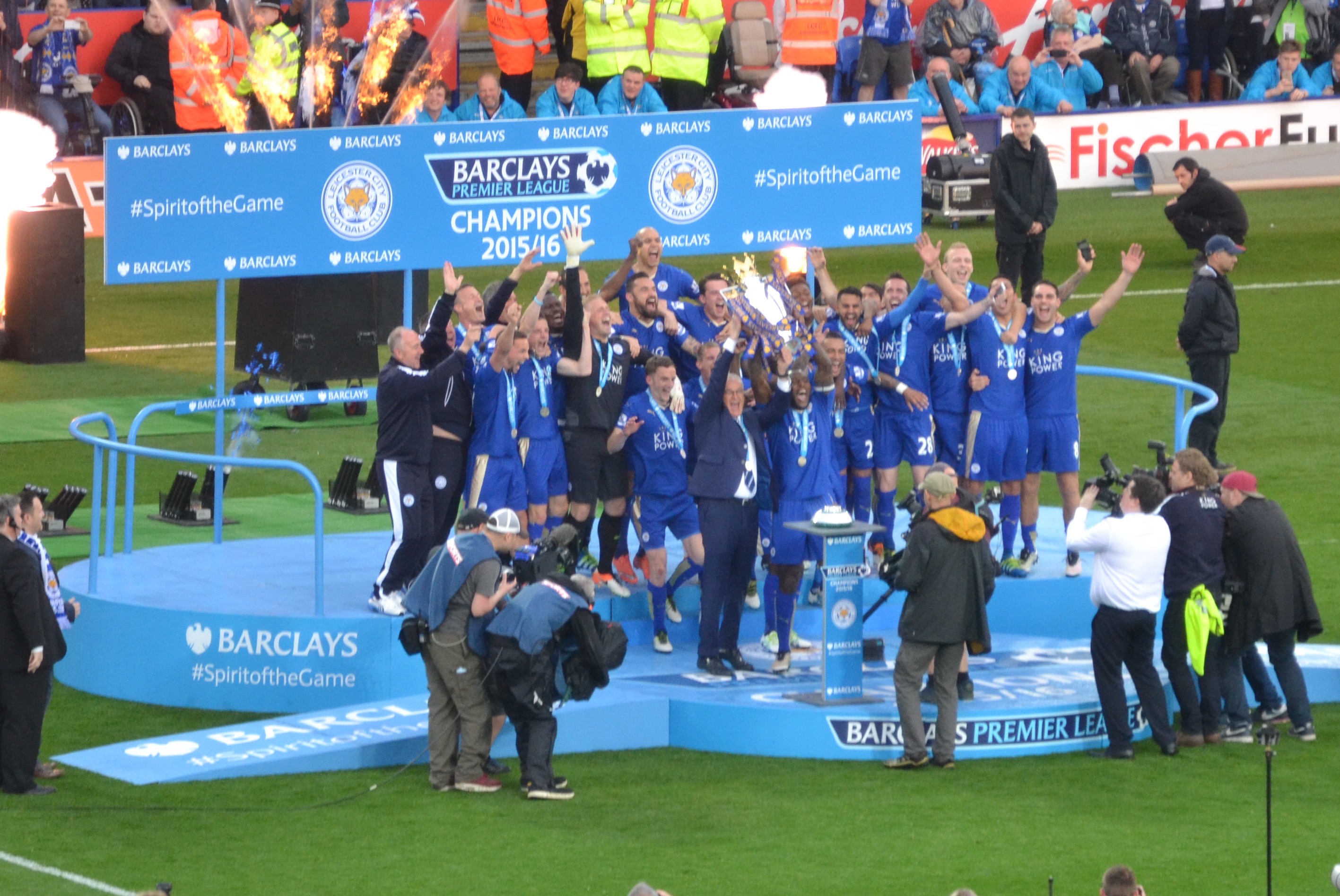
What happened next is told in full in our separate feature on the 2015–16 season: Claudio Ranieri's 5,000-1 outsiders won the Premier League, the title confirmed on 2 May 2016, with Jamie Vardy scoring in a record eleven consecutive matches. Ranieri was sacked the following February with the club a point above the relegation zone, even as Leicester reached the Champions League quarter-finals in their debut campaign. On 27 October 2018 the club was struck by tragedy when chairman Vichai Srivaddhanaprabha and four others died in a helicopter crash outside the King Power Stadium; his statue outside the ground was unveiled in 2022.

Under Brendan Rodgers, Leicester won 9–0 at Southampton in October 2019 — the joint-largest win in Premier League history and the largest away win in English top-flight history — finished fifth twice, and in May 2021 won the FA Cup for the first time, at the fifth attempt, beating Chelsea 1–0 through Youri Tielemans' goal. The Community Shield and a first European semi-final, in the 2022 Europa Conference League, followed. But Rodgers left in April 2023 with the club in the relegation zone, and Leicester went down that May, ending a nine-year Premier League stay. Enzo Maresca brought them straight back as Championship champions in 2023–24 — a record eighth second-tier title — before leaving for Chelsea, yet in 2025 Leicester were relegated from the Premier League again. The years since have brought further upheaval, and the club that produced English football's greatest fairy tale has fallen on hard times once more.
Honours
| Trophy | Titles | Years |
|---|---|---|
| League title (Premier League) | 1 | 2015–16 |
| FA Cup | 1 | 2021 |
| League Cup | 3 | 1964, 1997, 2000 |
| FA Charity Shield / Community Shield | 2 | 1971, 2021 |
| Second Division / Championship | 8 (record) | 1924–25, 1936–37, 1953–54, 1956–57, 1970–71, 1979–80, 2013–14, 2023–24 |
| League One | 1 | 2008–09 |
Leicester's record scorer is Arthur Chandler, with 273 goals between 1923 and 1935, and their record appearance maker is Graham Cross, with 600 appearances (long listed as 599; the club now counts the 1971 Charity Shield). Adam Black holds the club record for league appearances, with 528 between 1920 and 1935.
Timeline
- 1884 — Wyggeston School old boys form the club as Leicester Fosse.
- 1891 — The club moves to Filbert Street, its home for 111 years; joins the Midland League.
- 1894 — Elected to the Football League (Division Two).
- 1919 — After Leicester Fosse ceases trading, the club is reformed as Leicester City as Leicester gains city status.
- 1924–25 — First Second Division title under Peter Hodge.
- 1928–29 — First Division runners-up by one point — the club's best finish until 2016; Arthur Chandler is the era's record-breaking scorer (273 career goals).
- 1949 — First FA Cup final (lost to Wolves).
- 1961 / 1963 — FA Cup finals under Matt Gillies; first European football in the 1961–62 Cup Winners' Cup.
- 1964 — First major trophy: the League Cup (beat Stoke City on aggregate).
- 1971 — Second Division champions and FA Charity Shield winners (beat Liverpool 1–0) as Jimmy Bloomfield takes over.
- 1997 & 2000 — League Cups under Martin O'Neill, with UEFA Cup football in between.
- 2002 — Move to the Walkers Stadium (later King Power Stadium); administration with £30m debts in October.
- 2008–09 — After the club's first-ever relegation to the third tier, Nigel Pearson wins League One at the first attempt.
- 2013–14 — Championship champions under Pearson; back in the Premier League after ten years.
- 2014–15 — The Great Escape: seven wins in the last nine games from bottom of the table.
- 2 May 2016 — Premier League champions at 5,000-1 under Claudio Ranieri (see the separate Yavex feature, leicester-5000-1-title).
- 2016–17 — Champions League quarter-finalists in their debut campaign.
- 27 October 2018 — Chairman Vichai Srivaddhanaprabha dies in the helicopter crash outside the King Power Stadium.
- 15 May 2021 — First FA Cup (1–0 vs Chelsea, Tielemans) at the fifth final attempt; Community Shield follows in August 2021.
- 2022 — First European semi-final (Europa Conference League, lost to Roma).
- 2023 — Relegated from the Premier League after nine years.
- 2023–24 — Championship champions — a record eighth second-tier title — and straight back up.
- 2025 — Relegated from the Premier League again.
References
- Wikipedia — "Leicester City F.C." (history, honours and records) and "List of Leicester City F.C. records and statistics".
- Leicester City FC — lcfc.com, official club history and King Power Stadium pages.
- Premier League Handbook (King Power Stadium capacity).
- Wikimedia Commons — file pages for the photographs used.
Image source: Wikimedia Commons.


