 YAVE
Sevilla
The Nervionenses' Story — Spain's Oldest Football-Only Club and Seven Europa Leagues

Sevilla Fútbol Club were founded on 25 January 1890 — Burns Night — as Sevilla Foot-ball Club, by British, mainly Scottish, expatriates together with Spaniards; their first president was the Scotsman Edward Farquharson Johnston, the British vice-consul. Sevilla are the oldest club in Spain founded solely for football; only Recreativo de Huelva (18 December 1889) is older, and Recreativo began as a multi-sport recreation club. Sevilla play at the Estadio Ramón Sánchez-Pizjuán, their home since 1958, with a capacity of 43,883.
Sevilla have won La Liga once, in 1945–46, and the Copa del Rey five times — but their fame rests on Europe: they have won the UEFA Cup / UEFA Europa League a record seven times, and all seven of their finals in the competition. Juan Arza is Sevilla's record scorer in official national competitions, with 207 goals in 414 official matches between 1943 and 1959, including a club-record 182 La Liga goals; Guillermo Campanal (Campanal I) scored more goals overall if the Andalusian regional championship is counted. Jesús Navas holds the club record with 705 official appearances in all competitions, across two spells (2003–2013 and 2017–2024).
Contents
- Foundation and Andalusian Dominance (1890–1934)
- First Division Arrival and the Golden 1940s (1934–1958)
- The Sánchez-Pizjuán Era: Stability and Lean Decades (1958–1992)
- Instability: Maradona, Administrative Relegation and the Drop (1992–2000)
- The Golden European Era (2000–2016)
- Lopetegui, the Seventh Title and Decline (2016–2025)
- Honours
- Timeline
- References
Foundation and Andalusian Dominance (1890–1934)

On 8 March 1890 Sevilla beat Huelva Recreation Club 2–0 at the Tablada Racecourse in the first official match played in Spain, Ritson scoring the first goal. The club's articles of association were formally registered on 14 October 1905 — the date from which the club celebrated its centenary in 2005. Sevilla dominated Andalusian football, winning the Campeonato Regional Sur 17 times, but missed out on a place in the inaugural La Liga after losing the deciding play-off to Racing de Santander in 1928. Promotion to the Primera División finally came in 1934.
First Division Arrival and the Golden 1940s (1934–1958)

The first division brought immediate silverware: the Copa del Rey in 1935, beating Sabadell, and again in 1939, a 6–2 win over Racing de Ferrol. The 1940s forward line was nicknamed los stukas, and in 1945–46 Sevilla won La Liga for the only time in their history, finishing one point ahead of Barcelona; a third Copa followed in 1948, a 4–1 win over Celta Vigo. The era also produced the club's biggest-ever league win, an 11–1 defeat of Barcelona in 1940–41. Sevilla were league runners-up four times in all — 1939–40, 1942–43, 1950–51 and 1956–57 — without ever adding a second title. Juan Arza, the era's defining player, won the Pichichi Trophy in 1954–55. Sevilla made their European Cup debut in 1957–58, reaching the quarter-finals. President Ramón Sánchez-Pizjuán, who had served 17 years in the role, died in October 1956, and the club's planned new stadium was named in his honour.
The Sánchez-Pizjuán Era: Stability and Lean Decades (1958–1992)
The Estadio Ramón Sánchez-Pizjuán opened on 7 September 1958, but the debt of building it forced player sales, and the decades that followed were lean ones of stability without trophies. Sevilla were relegated in 1968 and again in 1972 — though never below the Segunda División — and promoted back each time. In 1973 Biri Biri, from Gambia, became the club's first black player and a cult hero. The stadium hosted the 1982 World Cup semi-final between West Germany and France, and Sevilla returned to the UEFA Cup in the early 1980s. Toni Polster's 33 league goals in 1989–90 remain a club single-season league record.
Instability: Maradona, Administrative Relegation and the Drop (1992–2000)
Diego Maradona signed from Napoli in 1992, but his single season under Carlos Bilardo was unsuccessful. In 1995 Sevilla and Celta Vigo were relegated for administrative reasons and then reinstated after supporter protests. On the pitch, though, the drop came anyway: relegation in 1997 after 22 years in the top flight, promotion in 1999, and relegation again in 2000 amid institutional chaos — the low point from which the club's greatest era was built.
The Golden European Era (2000–2016)
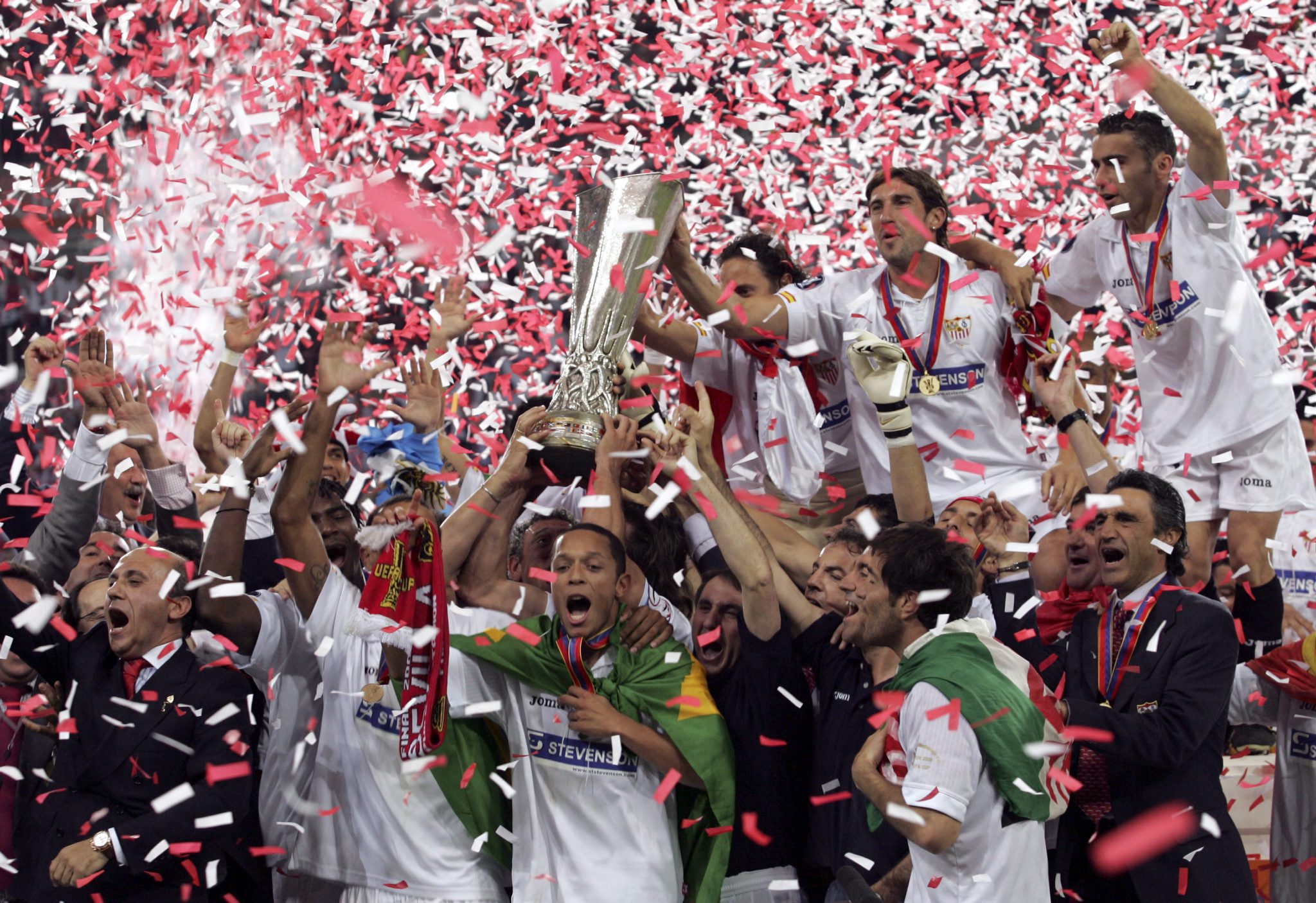
Joaquín Caparrós won the Segunda División in 2001, and president José María del Nido and sporting director Monchi then built a celebrated model of shrewd recruitment. Under Juande Ramos, Sevilla won back-to-back UEFA Cups — 4–0 against Middlesbrough in Eindhoven in 2006, and against Espanyol on penalties at Hampden Park in 2007 — plus the 2006 UEFA Super Cup, the 2007 Copa del Rey and the 2007 Supercopa; the IFFHS named Sevilla the World's Best Club in both 2006 and 2007. The era was marked by tragedy: defender Antonio Puerta collapsed during the opening league match of the 2007–08 season, against Getafe on 25 August 2007, and died three days later, on 28 August 2007, aged 22; the club's pre-season tournament now bears his name. A fifth Copa del Rey followed in 2010, and under Unai Emery Sevilla won the Europa League three years running — Benfica in 2014, Dnipro in 2015 and Liverpool in 2016 — despite the constant sale of stars such as Jesús Navas, Álvaro Negredo, Ivan Rakitić and Carlos Bacca. Frédéric Kanouté, the emblem of the Ramos side, scored 136 goals for the club.
Lopetegui, the Seventh Title and Decline (2016–2025)

Jorge Sampaoli's side reached the Champions League quarter-finals in 2017–18, the club's first in 60 years, beating Manchester United on the way. Julen Lopetegui (2019–2022) delivered a sixth Europa League title in 2020, a 3–2 win over Inter Milan in Cologne. The 2022–23 season was chaos — Lopetegui sacked in October, Sampaoli's return failing, relegation danger by March — until José Luis Mendilibar took over, steered the club to 12th place and won the Europa League on 31 May 2023, beating Roma on penalties in Budapest: a record seventh title. But the league decline continued, with finishes of 14th in 2023–24 and 17th in 2024–25, the latter after a relegation battle. In December 2024 Jesús Navas played his final match, away to Real Madrid on 22 December, and officially retired when his contract expired on 31 December 2024, aged 39, because of a chronic hip injury — ending a career that began with his debut in November 2003. Navas, who spent 2013–2017 at Manchester City, is the most decorated player in the club's history, with eight trophies at Sevilla, and also won the 2010 World Cup, Euro 2012, the 2023 Nations League and Euro 2024 with Spain.
Honours
| Competition | Titles | Years / notes |
|---|---|---|
| La Liga | 1 | 1945–46 (runners-up 1939–40, 1942–43, 1950–51, 1956–57) |
| Copa del Rey | 5 | 1935, 1939, 1948, 2007, 2010 |
| Supercopa de España | 1 | 2007 |
| UEFA Cup / UEFA Europa League | 7 (record) | 2006, 2007, 2014, 2015, 2016, 2020, 2023 — all seven finals won |
| UEFA Super Cup | 1 | 2006 (runners-up 2007, 2014, 2015, 2016, 2020, 2023) |
| UEFA–CONMEBOL Club Challenge | 1 | 2023 |
| Segunda División | 4 | 1929, 1933–34, 1968–69, 2000–01 |
| Campeonato Regional Sur | 17 | 1916–17 to 1939–40 |
Timeline
- 1890 — Founded on Burns Night, 25 January, as Sevilla Foot-ball Club; Edward Farquharson Johnston first president.
- 1890 — Sevilla beat Huelva Recreation Club 2–0 in the first official match played in Spain (8 March).
- 1905 — Articles of association registered with the Civil Government of Seville (14 October) — the club's official centenary was celebrated in 2005.
- 1928 — Sevilla miss out on the inaugural La Liga, losing the deciding play-off to Racing de Santander.
- 1934 — Promoted to the Primera División for the first time.
- 1935 — First Copa del Rey, beating Sabadell.
- 1939 — Second Copa, beating Racing de Ferrol 6–2.
- 1946 — La Liga champions for the only time, finishing one point ahead of Barcelona.
- 1948 — Third Copa del Rey, beating Celta Vigo 4–1.
- 1955 — Juan Arza wins the Pichichi Trophy.
- 1956 — President Ramón Sánchez-Pizjuán dies; the planned new stadium is named in his honour.
- 1958 — Estadio Ramón Sánchez-Pizjuán opens (7 September); Sevilla had made their European Cup debut in 1957–58, reaching the quarter-finals.
- 1968 — Relegated to the Segunda for the first time in 31 years; promoted back after one season (also relegated 1972, back 1975).
- 1982 — The Sánchez-Pizjuán hosts the World Cup semi-final between West Germany and France.
- 1992 — Diego Maradona signs from Napoli; his single season (1992–93) is unsuccessful.
- 1995 — Sevilla and Celta are relegated for administrative reasons, then reinstated after protests.
- 1997 — Relegated on the pitch after 22 years in the top flight; promoted 1999, relegated again 2000.
- 2001 — Joaquín Caparrós's side win the Segunda División and return to La Liga.
- 2006 — First UEFA Cup (4–0 v Middlesbrough) and the UEFA Super Cup (3–0 v Barcelona); IFFHS World's Best Club.
- 2007 — Second UEFA Cup (v Espanyol, penalties), Copa del Rey and Supercopa won; defender Antonio Puerta dies in August, days after collapsing in the season's opening match.
- 2010 — Fifth Copa del Rey (2–0 v Atlético Madrid; goals by Capel and Navas); the club keeps the trophy permanently.
- 2014 — Third Europa League title (v Benfica, penalties) under Unai Emery.
- 2015 — Fourth Europa League title (3–2 v Dnipro).
- 2016 — Fifth Europa League title (3–1 v Liverpool) — an unprecedented three in a row.
- 2020 — Sixth Europa League title (3–2 v Inter Milan) under Julen Lopetegui.
- 2023 — Seventh Europa League title (v Roma, penalties, Budapest) under José Luis Mendilibar, in a season of relegation danger and three managers.
- 2024 — Jesús Navas, the club's record appearance maker (705 games), retires in December.
- 2025 — Sevilla finish 17th in La Liga, surviving a relegation battle.
References
- Wikipedia — "Sevilla FC", "Juan Arza", "Recreativo de Huelva".
- Sevilla FC (sevillafc.es) — club history and records.
- UEFA.com — club facts; Europa League records.
- Guinness World Records — most UEFA Europa League titles.
- AFP — reports of Jesús Navas's retirement (December 2024).
- Wikimedia Commons — file pages for the photographs used.
Image source: Wikimedia Commons.


