 YAVE
SSC Napoli
Naples and Maradona — four Scudetti, bankruptcy and rebirth in the shadow of the volcano

Società Sportiva Calcio Napoli was founded on 1 August 1926 — the club's own official date — when Naples' first football club took the name Associazione Calcio Napoli under president Giorgio Ascarelli. Southern Italy's biggest club and its only major European trophy winner, Napoli have won four Scudetti, six Coppe Italia, three Supercoppe Italiane and the 1989 UEFA Cup. The first two titles came in the Maradona years, when the Argentine made Naples the centre of the football world; the club then went bankrupt in 2004, was refounded by film producer Aurelio De Laurentiis, climbed back from the third division, and won two more Scudetti in 2023 and 2025. They play at the Stadio Diego Armando Maradona — renamed for him in December 2020, days after his death — with a capacity of 54,726.
Contents
- The English game reaches Naples: FBC Naples to AC Napoli (1905–1945)
- The yo-yo years and the first cup (1945–1965)
- Building towards glory: Altafini, Sivori and the near misses (1965–1984)
- The Maradona era (1984–1991)
- Decline and bankruptcy (1991–2004)
- De Laurentiis: from Serie C to two more Scudetti (2004–2025)
- Honours
- Timeline
- References
The English game reaches Naples: FBC Naples to AC Napoli (1905–1945)
Football came to Naples with English sailors and merchants. Naples Foot-Ball Club was founded in 1905 — the date now accepted by historians — with the Englishman William Poths, an employee of the Cunard Line, as its first president; the club's English name is the direct ancestor of today's. In 1911 some members broke away to form Internazionale Napoli, and in October 1922 the two reunited as Foot-Ball Club Internaples. Four years later, under the businessman Giorgio Ascarelli, the club was renamed Associazione Calcio Napoli — the renaming of 1926, not a merger, is what the modern club dates itself from. Napoli joined the inaugural Serie A in 1929–30, finished third in 1932–33 and 1933–34 behind the Danish striker Attila Sallustro, the club's first great idol, and in 1938 signed a young midfielder from Nacional of Montevideo, Michele Andreolo, who went on to win the 1938 World Cup with Italy. Ascarelli's new stadium at Fuorigrotta, opened in 1930, hosted two matches of the 1934 World Cup.
The yo-yo years and the first cup (1945–1965)

War split the club in two; it reunified in 1945 and took its present name, Società Sportiva Calcio Napoli, in 1947. The post-war decades were unstable: the relegation of 1948 was imposed on the club amid a bribery scandal rather than earned on the pitch, and Napoli bounced between the divisions — relegated in 1961, promoted in 1962, down again in 1963, up again in 1965. Yet the era produced the club's first major trophy: the Coppa Italia of 1961–62, won as a Serie B side by beating SPAL 2–1 in the final in Rome on 21 June 1962, still one of only three wins by a second-tier club in the competition's history. Bruno Pesaola's side also won the Coppa delle Alpi in 1966. The old Fuorigrotta ground gave way on 6 December 1959 to the Stadio del Sole — renamed Stadio San Paolo in 1963 — opened with a 2–1 win over Juventus.
Building towards glory: Altafini, Sivori and the near misses (1965–1984)

The 1965 promotion began Napoli's longest top-flight stay. In 1968 the club signed José Altafini from Milan and Omar Sívori from Juventus — still the club's record signing fee is a modern matter, but the double capture was a sensation — and finished runners-up in 1967–68. The 1970s brought the great near miss: Luís Vinício's attacking side of 1974–75 finished second, two points behind Juventus, playing the "total football" that made them famous. The Coppa Italia of 1976 (4–0 against Verona in the final) and the Anglo-Italian League Cup of the same year were real silverware, and on 15 December 1974 a crowd of 90,736 — the stadium's record attendance — watched a league match against Juventus. Corrado Ferlaino, president in three spells between 1969 and 1993, rebuilt repeatedly; under Rino Marchesi, Ruud Krol's Napoli finished third in 1980–81, a point off the title, and in 1983–84 survived relegation by a single point. The club was competitive but not rich — and then, in the summer of 1984, it signed the best player in the world.
The Maradona era (1984–1991)
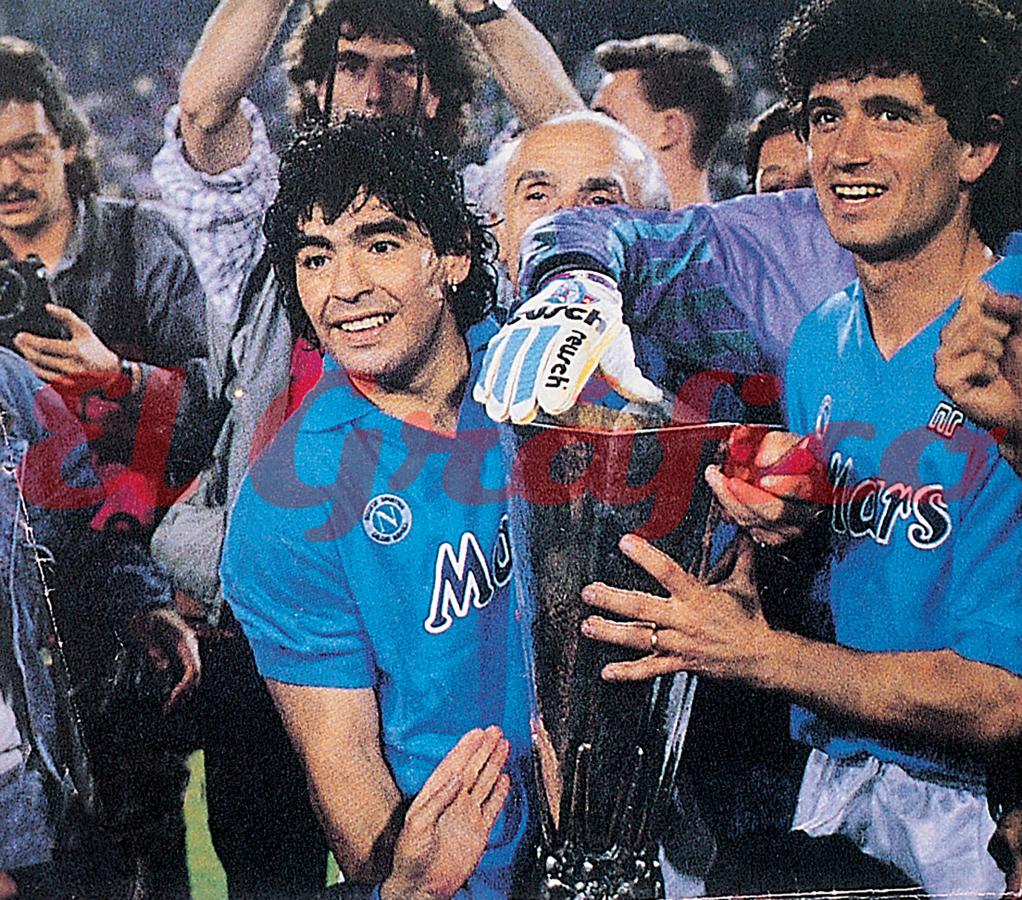
On 30 June 1984 Napoli agreed to sign Diego Maradona from Barcelona for £6.9 million, a world record; on 5 July he was presented at the San Paolo before a crowd reported at around 75,000. Coach Ottavio Bianchi built around him — Ciro Ferrara from the academy, then Careca and Alemão — and on 10 May 1987 the first Scudetto was secured: Napoli became the first club from mainland southern Italy to win the Italian championship. The Coppa Italia followed in June, won with 13 victories in 13 matches: the double. Runners-up twice more, Napoli then conquered Europe: the 1989 UEFA Cup, beaten finalists VfB Stuttgart seen off 5–4 on aggregate — 2–1 at the San Paolo, 3–3 in Stuttgart, Maradona scoring once in each leg. The second Scudetto came in 1989–90, sealed on the final day, and the Supercoppa Italiana that autumn, a 5–1 demolition of Juventus. Maradona's Napoli tally stands at 115 goals in 259 appearances in all competitions — 81 of them in Serie A, 29 in the Coppa Italia and five in the UEFA Cup — the fourth-highest total in the club's history. In March 1991 he failed a drug test, was banned for 15 months and never played for Napoli again; the club retired his No. 10 shirt in 2000.
Decline and bankruptcy (1991–2004)
Without Maradona, Napoli briefly stayed near the top — fourth in 1991–92 — but the debts of the Ferlaino years caught up. The club finished 14th in 1995–96, lost the 1997 Coppa Italia final to Vicenza, and in 1997–98 won just two league matches all season and went down. Ownership passed through Giorgio Corbelli and Salvatore Naldi; a play-off defeat by Perugia in 2001 kept Napoli in Serie B, and in August 2004 the club was declared bankrupt. Maradona's shadow lay over the empty years: the San Paolo's record crowd for a league match was by then a memory, and Serie C football, under a new name, was the only future on offer.
De Laurentiis: from Serie C to two more Scudetti (2004–2025)

Film producer Aurelio De Laurentiis bought the club's sporting title at auction for a figure reported at around €31 million, and on 6 September 2004 the refounded club began life as Napoli Soccer in Serie C1. The old name, Società Sportiva Calcio Napoli, was restored in May 2006; promotion to Serie B came that year and to Serie A in 2007 — back-to-back promotions. Walter Mazzarri's side won the Coppa Italia in 2012, beating the unbeaten champions Juventus — Napoli's first trophy in 22 years — and Rafa Benítez added the Coppa Italia and Supercoppa of 2014. The records belong to this era: Marek Hamšík, the captain, made 520 appearances in all competitions, the club record; Dries Mertens became the record scorer with 148 goals in all competitions, 113 of them in the league; Gonzalo Higuaín's 36 league goals in 2015–16 set the Serie A single-season record. Maurizio Sarri's side took 91 points in 2017–18 and still finished second. The sixth Coppa Italia came in 2020, on penalties against Juventus. Then, under Luciano Spalletti, the third Scudetto: clinched on 4 May 2023 with a 1–1 draw at Udinese, five matches to spare, finishing on 90 points — the first title of the post-Maradona era. Spalletti left; two seasons later Antonio Conte delivered the fourth Scudetto on the final day of 2024–25, 23 May 2025, Napoli's 82 points edging Inter's 81. In December 2025, in Riyadh, Napoli added a third Supercoppa Italiana, beating Milan 2–0 in the semi-final and Bologna 2–0 in the final on 22 December. The stadium, renamed for Maradona on 4 December 2020, nine days after his death, remains the city's cathedral.
Honours
| Competition | Titles | Years / best |
|---|---|---|
| Serie A | 4 | 1986–87, 1989–90, 2022–23, 2024–25; runners-up 1967–68, 1974–75, 1987–88, 1988–89, 2012–13, 2015–16, 2017–18, 2018–19 |
| Coppa Italia | 6 | 1961–62 (won as a Serie B club), 1975–76, 1986–87, 2011–12, 2013–14, 2019–20; runners-up 1971–72, 1977–78, 1988–89, 1996–97 |
| Supercoppa Italiana | 3 | 1990, 2014, 2025 (December 2025 edition); runners-up 2012, 2020 |
| UEFA Cup | 1 | 1989 (5–4 on aggregate v VfB Stuttgart); best Champions League run: quarter-finals 2022–23 |
| Minor / wartime | — | Coppa delle Alpi 1966; Anglo-Italian League Cup 1976; Serie B 1949–50; Serie C1 2005–06 |
Timeline
- 1905 — Naples Foot-Ball Club is founded (the date accepted by historians) with William Poths as first president.
- 1911 — Internazionale Napoli breaks away.
- October 1922 — The two clubs reunite as Foot-Ball Club Internaples.
- 1 August 1926 — The club takes the name Associazione Calcio Napoli under president Giorgio Ascarelli — the foundation date the club itself uses.
- 1929–30 — Napoli play in the first Serie A season.
- 1932–33 / 1933–34 — Third-place finishes behind Attila Sallustro.
- 1938 — Michele Andreolo, signed by Napoli, wins the World Cup with Italy.
- 1947 — The club takes its present name, Società Sportiva Calcio Napoli.
- 1948 — Relegation imposed amid a bribery scandal.
- 6 December 1959 — The Stadio del Sole opens with a 2–1 win over Juventus; renamed Stadio San Paolo in 1963.
- 21 June 1962 — The Coppa Italia is won as a Serie B club (2–1 v SPAL in Rome).
- 1968 — José Altafini and Omar Sívori sign; Napoli finish runners-up.
- 15 December 1974 — Record crowd of 90,736 for a league match v Juventus.
- 1974–75 — Second place, two points behind Juventus, under Luís Vinício.
- 1976 — Coppa Italia (4–0 v Verona) and the Anglo-Italian League Cup.
- 30 June 1984 — Diego Maradona's signing from Barcelona is agreed for a world-record £6.9 million; he is presented on 5 July before around 75,000 fans.
- 10 May 1987 — The first Scudetto: Napoli are the first mainland southern champions of Italy.
- June 1987 — The Coppa Italia completes the double, won with 13 wins in 13 matches.
- May 1989 — The UEFA Cup: Stuttgart beaten 5–4 on aggregate.
- 29 April 1990 — The second Scudetto, sealed on the final day; the Supercoppa follows (5–1 v Juventus).
- March 1991 — Maradona fails a drug test, is banned for 15 months and leaves Napoli.
- 1997–98 — Relegated with just two league wins.
- August 2004 — SSC Napoli is declared bankrupt.
- 6 September 2004 — Aurelio De Laurentiis' refounded club, Napoli Soccer, begins in Serie C1.
- May 2006 — The SSC Napoli name is restored; promotion to Serie B.
- June 2007 — Promotion to Serie A completes back-to-back promotions.
- 20 May 2012 — The Coppa Italia (2–0 v Juventus): the first trophy in 22 years.
- 2014 — Coppa Italia and Supercoppa Italiana under Rafa Benítez.
- 2015–16 — Gonzalo Higuaín scores 36 league goals, a Serie A single-season record.
- 17 June 2020 — The sixth Coppa Italia, on penalties v Juventus.
- 4 December 2020 — The stadium is renamed Stadio Diego Armando Maradona.
- 4 May 2023 — The third Scudetto is clinched at Udinese, five matches early; Napoli finish on 90 points.
- 23 May 2025 — The fourth Scudetto, won on the final day (82 points to Inter's 81) under Antonio Conte.
- 22 December 2025 — The third Supercoppa Italiana, in Riyadh (final: 2–0 v Bologna).
References
- SSC Napoli — club history, honours and records, English and Italian Wikipedia (cross-checked); SSC Napoli official site (sscnapoli.it) — the foundation page (1 August 1926, the Ascarelli renaming) and the 2025 Supercoppa report (final 2–0 v Bologna, Riyadh, 22 December 2025).
- History of SSC Napoli, English Wikipedia (the October 1922 Internaples merger; Naples FBC 1905; the 1948 imposed relegation); Maradona at Napoli, English Wikipedia (the £6.9m world-record fee; 115 goals in 259 appearances; the 1989 UEFA Cup won 5–4 on aggregate).
- Stadio Diego Armando Maradona, English Wikipedia (capacity 54,726; opened 6 December 1959; renamed 4 December 2020); RSSSF — Napoli's all-time table (Sallustro's 111 league goals); Lega Serie A official palmares (4 Scudetti, 6 Coppe Italia, 3 Supercoppe).
Image source: Wikimedia Commons.


