 YAVE
Tottenham Hotspur
The history of Tottenham Hotspur: from a lamppost meeting to the Double, European firsts and the end of a 17-year drought

Tottenham Hotspur began under a lamppost. In September 1882, schoolboys from Saint John's Middle Class School and Tottenham Grammar School — members of the Hotspur Cricket Club who wanted a sport for the winter — agreed to form a football club on Tottenham High Road. Led by Bobby Buckle, the first captain, they called it Hotspur Football Club; in April 1884 it became Tottenham Hotspur, after Harry Hotspur of the Northumberland family, to avoid confusion with another London club of the same name.
Spurs, the Lilywhites, have been north London's great cup romantics ever since: the only non-League club to win the FA Cup, winners of the first Double of the twentieth century, the first British club to win a European trophy, and — after a 17-year wait ended in 2025 — European trophy winners again. They played at White Hart Lane from 1899 to 2017 and now fill the 62,850-capacity Tottenham Hotspur Stadium, built on the same site.
Contents
- Formation and the Non-League FA Cup (1882–1908)
- Early Football League Decades (1908–1949)
- Arthur Rowe and "Push and Run" (1949–1958)
- Bill Nicholson and the Glory Years (1958–1974)
- Burkinshaw, Venables and the 1980s Cups (1974–1992)
- Premier League Near Misses and the Drought Ends (1992–2025)
- Honours
- Timeline
- References
Formation and the Non-League FA Cup (1882–1908)
The boys' club played first on public land at Tottenham Marshes, then from 1888 on a rented pitch at Northumberland Park. Spurs turned professional in December 1895, joined the Southern League in 1896, and in 1899 moved to White Hart Lane, winning their first game there 4–1 against Notts County before 5,000 spectators. Under player-manager John Cameron they won the Southern League title in 1899–1900 — and then produced the result that still defines their early history. In 1901, still a non-League club, Spurs beat Sheffield United 3–1 in a replay to win the FA Cup. They remain the only non-League club to win the trophy since the Football League was formed in 1888.
Early Football League Decades (1908–1949)

Spurs were elected to the Football League's Second Division in 1908 and promoted at the first attempt. Peter McWilliam, manager from 1912, built the side that won the Second Division in 1919–20 and, on 23 April 1921, a second FA Cup, beating Wolverhampton Wanderers 1–0 with Arthur Grimsdell as captain. Spurs finished league runners-up in 1922, but the decades that followed were mostly spent in the Second Division, apart from two seasons in the top flight in the mid-1930s. White Hart Lane's record crowd of 75,038 came in an FA Cup tie against Sunderland in 1938 — a reminder of the support waiting for a team worth watching.
Arthur Rowe and "Push and Run" (1949–1958)
It arrived under Arthur Rowe, a former Spurs player who became manager in 1949 and taught the team his "push and run" style: pass the ball quickly, move into space, keep it simple. Rowe's side won the Second Division in 1949–50 and then, in 1950–51, the First Division championship — the first league title in the club's history, won a season after promotion. Ill health forced Rowe to resign in April 1955, but before leaving he signed the Northern Irish wing-half Danny Blanchflower, twice Footballer of the Year at Spurs and the leader of the great side to come.
Bill Nicholson and the Glory Years (1958–1974)

Bill Nicholson took over in October 1958 and became the most successful manager in Tottenham's history, winning eight major trophies in 16 years. His team of Blanchflower, Dave Mackay, John White and, from 1961, the great goalscorer Jimmy Greaves won the League and FA Cup Double in 1960–61 — the first Double of the twentieth century, the league sealed with three games to spare after a season that began with 11 straight wins. The FA Cup was retained in 1962. On 15 May 1963 Spurs thrashed Atlético Madrid 5–1 to win the European Cup Winners' Cup, becoming the first British club to win a European trophy. There was another FA Cup in 1967, League Cups in 1971 and 1973, and in 1971–72 Spurs won the inaugural UEFA Cup — the first British club to win two different major European trophies. Steve Perryman, who would reach a club-record 854 appearances, anchored the later Nicholson sides.
Burkinshaw, Venables and the 1980s Cups (1974–1992)

Nicholson's resignation in 1974 began a decline that ended in relegation in 1976–77. Keith Burkinshaw brought Spurs straight back up and rebuilt around Glenn Hoddle and two signings that were unusual for English football of the time, the Argentinians Osvaldo Ardiles and Ricardo Villa. Burkinshaw's team won the FA Cup in 1981 and 1982 and the UEFA Cup in 1984. Terry Venables took over in 1987, signed Paul Gascoigne and Gary Lineker, and in 1990–91 won the FA Cup again — Spurs becoming the first club to win the trophy eight times. Clive Allen's 49 goals in 1986–87 remained a club season record from the decade.
Premier League Near Misses and the Drought Ends (1992–2025)
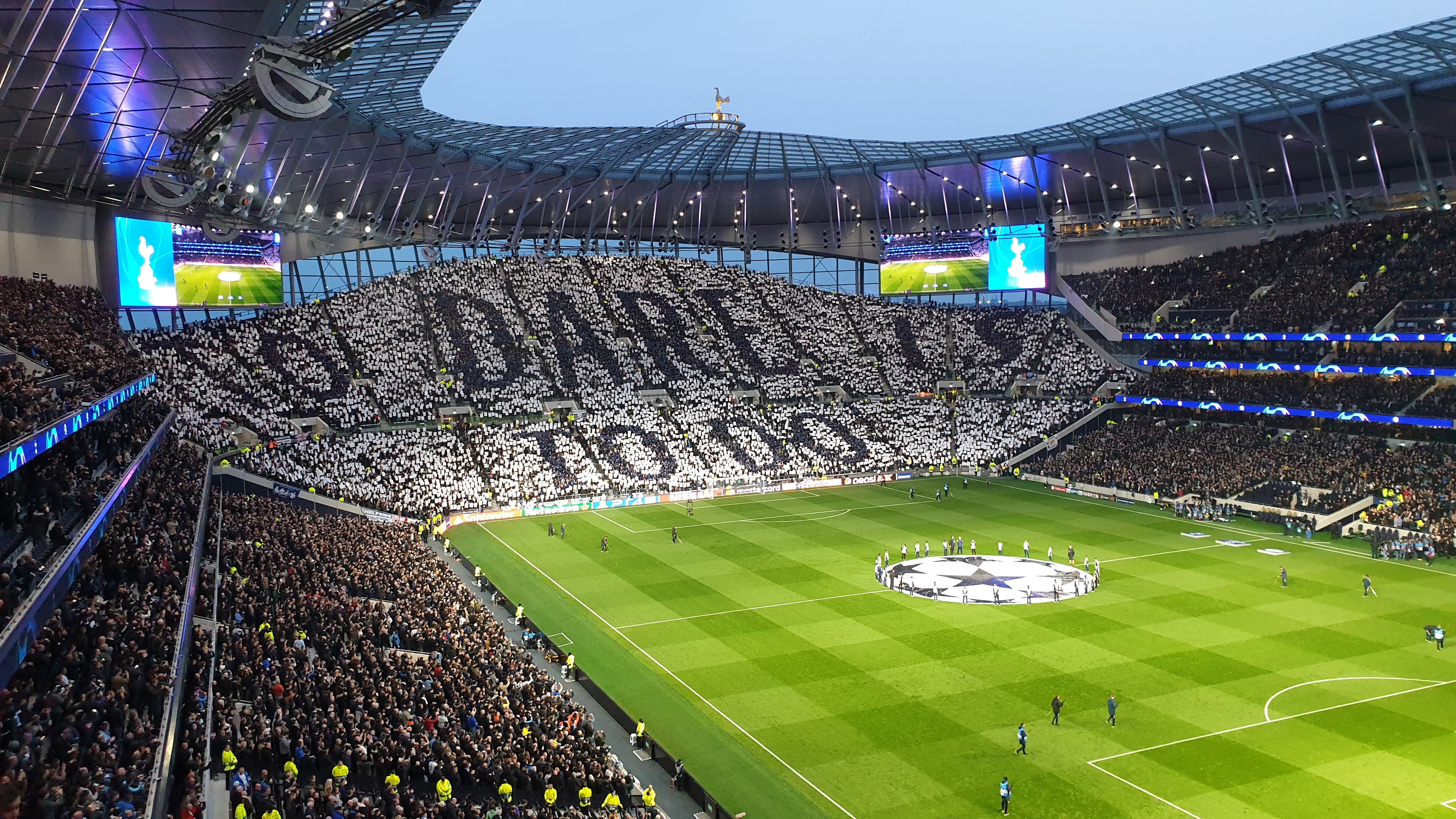
Spurs were among the clubs that pushed for the Premier League's creation, but for years they watched others win it. ENIC bought control of the club in 2001. League Cups in 1999 and 2008 were the only major trophies of a long stretch, the 2008 win beginning a drought that lasted 17 years. Under Harry Redknapp, with Gareth Bale and Luka Modrić, Spurs became regular top-five finishers; under Mauricio Pochettino they finished second in 2016–17 — their highest placing since 1962–63 — and in 2019 reached the club's first Champions League final, losing 2–0 to Liverpool. That spring they also moved home: after a temporary stay at Wembley, the Tottenham Hotspur Stadium opened on 3 April 2019 with a 2–0 win over Crystal Palace. Academy graduate Harry Kane passed Jimmy Greaves in February 2023 to become the club's record scorer with 280 goals — though Greaves's 220 league goals remain the club league record — before leaving for Bayern Munich that summer. In May 2025, under Ange Postecoglou, Spurs beat Manchester United 1–0 in Bilbao to win the UEFA Europa League and end the long drought — even as a 17th-place league finish, the club's worst of the Premier League era, cost Postecoglou his job.
Honours
| Trophy | Titles | Years |
|---|---|---|
| League title (First Division) | 2 | 1950–51, 1960–61 |
| FA Cup | 8 | 1900–01, 1920–21, 1960–61, 1961–62, 1966–67, 1980–81, 1981–82, 1990–91 |
| League Cup | 4 | 1970–71, 1972–73, 1998–99, 2007–08 |
| FA Charity Shield / Community Shield | 7 | 1921, 1951, 1961, 1962, 1967, 1981, 1991 (the last three shared) |
| European Cup Winners' Cup | 1 | 1962–63 |
| UEFA Cup / UEFA Europa League | 3 | 1971–72, 1983–84, 2024–25 |
Spurs won at least one major trophy in every decade from the 1950s to the 2000s — an achievement matched only by Manchester United. Their record scorer is Harry Kane with 280 goals, and their record appearance maker is Steve Perryman with 854 appearances between 1969 and 1986.
Timeline
- 1882 — Hotspur FC formed on 5 September by schoolboys from Saint John's Middle Class School and Tottenham Grammar School, members of Hotspur Cricket Club, led by Bobby Buckle.
- 1884 — The club is renamed Tottenham Hotspur Football Club in April, to avoid confusion with another London Hotspur.
- 1899 — Move to White Hart Lane; the first game, on 4 September, is a 4–1 friendly win over Notts County.
- 1901 — FA Cup winners as a non-League club, beating Sheffield United 3–1 in a replay — still the only non-League club to win it since 1888.
- 1921 — Second FA Cup, beating Wolverhampton Wanderers 1–0 under Peter McWilliam.
- 1951 — First league championship: Arthur Rowe's "push and run" side win the First Division a season after promotion.
- 1961 — Bill Nicholson's side win the League and FA Cup Double — the first Double of the twentieth century.
- 1963 — European Cup Winners' Cup won 5–1 against Atlético Madrid — Spurs become the first British club to win a European trophy.
- 1972 — Inaugural UEFA Cup winners; first British club to win two different major European trophies. A further UEFA Cup follows in 1984 under Keith Burkinshaw.
- 2019 — First Champions League final, lost 2–0 to Liverpool, and the move into Tottenham Hotspur Stadium, opened 3 April after a temporary stay at Wembley.
- 2025 — UEFA Europa League won under Ange Postecoglou, 1–0 against Manchester United — a first major trophy in 17 years, since the 2008 League Cup.
References
- Wikipedia — "Tottenham Hotspur F.C." and "History of Tottenham Hotspur F.C.".
- Wikipedia — "List of Tottenham Hotspur F.C. records and statistics".
- Premier League — official stadiums guide (Tottenham Hotspur Stadium capacity).
- Wikimedia Commons — file pages for the photographs used.
Image source: Wikimedia Commons.


