 YAVE
Udinese Calcio
The Friuli model: scouting the world from Italy's north-east since 1896
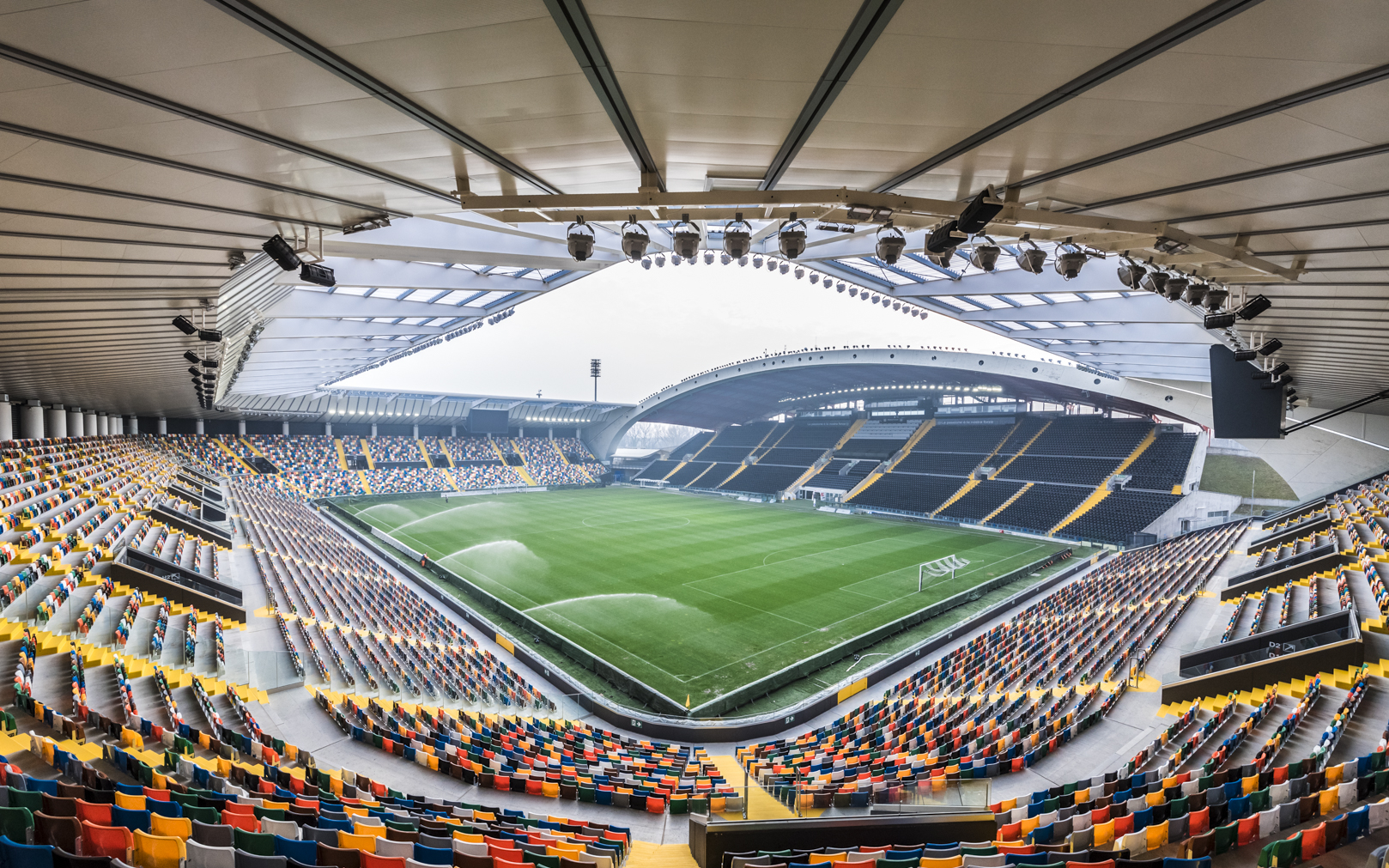
Udinese Calcio are the club of Udine, in Italy's far north-east, a few kilometres from the Slovenian border — and for three decades they have been the model of how a small-city club survives in Serie A: a scouting network spanning the world, a stadium they rebuilt with their own money, and an academy of finds sold on to Europe's giants. The club's official foundation date is 30 November 1896, making Udinese one of Italy's oldest sporting institutions, though the football club proper dates from 1911.
The Bianconeri of Friuli have never won Serie A — their best finish is second, in 1954–55 — nor the Coppa Italia, which they came within one match of lifting in 1922. What they have done, since the Pozzo family bought the club in 1986, is outlast almost everyone: the 2025–26 season was their 31st consecutive campaign in the top flight.
Contents
- Gymnasts first: the 1896 society and the road to a football club (1896–1911)
- The football club: early championships and the 1922 cup final (1911–1945)
- Runners-up, scandal and redemption (1945–1957)
- The yo-yo decades: the Friuli stadium and Zico (1957–1986)
- The Pozzo revolution: scouting the world (1986–2005)
- Champions League nights, Di Natale and the rebuilt stadium (2005–2026)
- Honours
- Timeline
- References
1. Gymnasts first: the 1896 society and the road to a football club (1896–1911)
Udinese began as the Società Udinese di Ginnastica e Scherma — a gymnastics and fencing society — founded on 30 November 1896, the date the club officially celebrates (the Italian record calls the day "probable"; it is printed here as the club's official date). Football was played under the society's umbrella remarkably early: in September 1895, in Rome, an Udinese side played a friendly before King Umberto I. In September 1896 the society's team won a tournament at Treviso organised by the gymnastics federation — a victory in "calcio ginnastico" that is part of the club's folklore but is not, and has never been counted as, an official football title.
The football club proper was constituted on 5 July 1911 as Associazione Calcio Udinese. Its debut was emphatic: a 6–0 win over Juventus Palmanova — a local Friulian side, not the Turin giants of the same name.
2. The football club: early championships and the 1922 cup final (1911–1945)

Udinese's first brush with a national trophy came in the very first Coppa Italia, in 1922, when they reached the final and lost 0–1 after extra time to Vado — a small Ligurian club whose name would otherwise be forgotten, and the closest Udinese have ever come to a major honour. In the league, the club won the Second Division in 1924–25 — the second tier of its day — and the Prima Divisione in 1929–30 as the championship structure settled. One episode from 1926 is recorded with embarrassment: drawn into a play-off at Viareggio for a top-flight place, Udinese failed to appear and lost the place by default.
The 1930s and the war years were spent mostly outside the top division, and the club that emerged in 1945 was still waiting for its defining decade.
3. Runners-up, scandal and redemption (1945–1957)

Udinese won Serie C in 1948–49 and climbed to Serie A, and in 1954–55 they produced the finest league season in their history: second place, behind only Milan (48 points to Udinese's 44). But the triumph was shadowed by an offence committed on 31 May 1953, in a match at Busto Arsizio where Udinese had come from 0–2 down to beat Pro Patria 3–2. A confession by the player Settembrino brought the affair to light, and on 1 August 1955 the Lega relegated Udinese — while expressly leaving the 1954–55 runners-up finish standing. No Udinese director was found personally responsible.
The response on the pitch was immediate: Udinese won Serie B in 1955–56 and finished fourth in Serie A in 1956–57. The runners-up season was never revoked, and it remains the summit of the club's league history.
4. The yo-yo decades: the Friuli stadium and Zico (1957–1986)

The following decades were restless. Udinese won Serie B again in 1978–79 and the Mitropa Cup in 1979–80; that same season they were relegated on the pitch, finishing 15th, but were reprieved when the Totonero scandal relegated Milan and Lazio instead. In 1976 the club moved into the new Stadio Friuli, inaugurated on 26 September 1976, and on 8 June 1976 the modern name Udinese Calcio was adopted. Serie C titles in 1977–78 completed the era's lower-division honours.
Then, in 1983, came the signing that still defines the club's glamour: Zico, the Brazilian genius, arrived from Flamengo. In two injury-interrupted seasons he played 39 Serie A matches and scored 22 goals — 53 appearances and 30 goals in all competitions — and 26,611 season tickets were sold in a city of 100,000. Zico left in 1985, and within a year the club was in crisis and changing hands.
5. The Pozzo revolution: scouting the world (1986–2005)
Giampaolo Pozzo bought Udinese on 28 July 1986. The start was turbulent: the Totonero-bis affair brought a nine-point penalty in 1986–87, the side finished last and was relegated — it would have survived without the deduction — and a separate 1990 case brought a further five-point penalty and a five-year ban for Pozzo himself. The revolution came from within the family: from 1993–94, Pozzo's son Gino built the scouting network that became the club's engine, identifying and selling on players of the calibre of Alexis Sánchez, Samir Handanović, Medhi Benatia, Gökhan Inler, Juan Cuadrado and Piotr Zieliński.
Udinese's Serie A run began in 1995–96 and has never since been broken. They finished third in 1997–98, won the Intertoto Cup in 2000 — one of that season's three winners, beating Sigma Olomouc 6–4 on aggregate — and fourth in 2004–05, earning a first Champions League place. The Pozzo model spread: Granada was bought in 2009 (and sold on 16 June 2016), and Watford followed in June 2012, run by Gino Pozzo.
6. Champions League nights, Di Natale and the rebuilt stadium (2005–2026)

The 2005–06 Champions League group campaign ended with Udinese third in their group, level on seven points with Werder Bremen and eliminated on the head-to-head record. A fourth place in 2010–11 brought two more Champions League play-off campaigns, and through it all one man embodied the club: Antonio Di Natale, who scored 191 Serie A goals in 385 appearances for Udinese — 227 goals in 446 matches in all competitions. His 209 career Serie A goals, a total that includes his earlier years at Empoli, stand as a career figure only. Behind him, Valerio Bertotto's 404 appearances in all competitions (323 in Serie A) mark the club's appearance summit of the modern era.
The Stadio Friuli was rebuilt between 2013 and 2016, fully reopening on 17 January 2016 — the day it also took the sponsored name Dacia Arena. Since 27 September 2023 it has been the Bluenergy Stadium; its capacity is 25,132. Reported talks in 2025 over a sale to Guggenheim interests were never completed, and Pozzo ownership — continuous since 1986 — continues. Udinese closed the 2025–26 season 10th with 50 points, their 31st consecutive season in Serie A since the run began in 1995–96.
Honours
| Competition | Success | Notes |
|---|---|---|
| Serie A | Best finish: 2nd, 1954–55 | Never champions; 3rd in 1997–98, 4th in 1956–57, 2004–05 and 2010–11 |
| Coppa Italia | Finalists 1922 | Lost 0–1 after extra time to Vado; never won |
| Serie B | Champions 1955–56, 1978–79 | Also Second Division champions 1924–25 (the second tier of its day) |
| Mitropa Cup | Winners 1979–80 | Pre-UEFA European competition |
| UEFA Intertoto Cup | Winners 2000 | One of three winners that season; beat Sigma Olomouc 6–4 agg. |
| Prima Divisione / Serie C | Champions 1929–30; 1948–49, 1977–78 | Third-tier titles |
Timeline
- 1895 — September: an Udinese side plays a friendly in Rome before King Umberto I.
- 1896 — 30 November: the Società Udinese di Ginnastica e Scherma is founded — the club's official foundation date. The September Treviso gymnastics-federation tournament is won (not an official football title).
- 1911 — 5 July: the football club proper, Associazione Calcio Udinese, is constituted; the debut is a 6–0 win over Juventus Palmanova.
- 1922 — Coppa Italia final: Udinese lose 0–1 after extra time to Vado.
- 1926 — The Viareggio play-off: Udinese fail to appear and lose the top-flight place by default.
- 1953 — 31 May: the Pro Patria match at Busto Arsizio that later brings the Lega's ruling.
- 1955 — 1 August: Udinese are relegated by the Lega's ruling; the 1954–55 runners-up finish (44 points, behind Milan's 48) stands.
- 1955–56 — Serie B champions; 1956–57: fourth in Serie A.
- 1976 — The Stadio Friuli opens on 26 September; the name Udinese Calcio dates from 8 June.
- 1979–80 — Mitropa Cup winners; relegated on the pitch but reprieved by the Totonero relegations of Milan and Lazio.
- 1983–85 — The Zico years: 39 Serie A appearances, 22 goals; 26,611 season tickets sold.
- 1986 — 28 July: Giampaolo Pozzo buys the club. The Totonero-bis nine-point penalty follows; Udinese finish last and are relegated.
- 1995–96 — The unbroken Serie A run begins.
- 1997–98 — Third in Serie A, the best finish of the Pozzo era to that point.
- 2000 — Intertoto Cup winners (one of three), beating Sigma Olomouc 6–4 on aggregate.
- 2004–05 — Fourth place and a first Champions League qualification; the 2005–06 group ends level on points with Werder Bremen, out on head-to-head.
- 2016 — 17 January: the rebuilt stadium fully reopens as the Dacia Arena.
- 2023 — 27 September: the stadium becomes the Bluenergy Stadium (capacity 25,132).
- 2026 — Udinese finish the 2025–26 season 10th with 50 points — their 31st consecutive Serie A season.
References
- Udinese Calcio — club history, honours and records, cross-checked against the Italian and English reference records of the 1954–55 season, the 1922 Coppa Italia and the Bluenergy Stadium (capacity 25,132).
- UEFA records of the 2000 Intertoto Cup and the 2005–06 Champions League group stage.
Image source: Wikimedia Commons.


