 YAVE
West Bromwich Albion
The history of West Bromwich Albion: the Baggies, five FA Cups and the Three Degrees

West Bromwich Albion were founded in 1878 as West Bromwich Strollers by workers from George Salter's Spring Works in the Black Country. Renamed West Bromwich Albion in 1880, the club — the Baggies, the Throstles, the Albion — moved to The Hawthorns in 1900, their home ever since. At 551 feet above sea level, it is the highest of all 92 Premier League and Football League grounds, with a capacity of 26,688.
Albion were champions of England once, in 1919–20, and are five-time FA Cup winners — 1888, 1892, 1931, 1954 and 1968 — with a League Cup win in 1966. One man holds both great records: Tony "Bomber" Brown, scorer of 279 goals in 720 appearances between 1963 and 1981, who played in both the 1966 and 1968 triumphs. The "Baggies" nickname, first heard at The Hawthorns in the 1900s, has an origin that is genuinely disputed — theories range from the club's leather-bag "bagmen", who carried the matchday takings, to the baggy work trousers of Black Country foundry workers, a name said to have been bestowed by Aston Villa rivals; the older nickname, the Throstles, comes from the song thrush on the club badge.
Contents
- Strollers, Stoney Lane and the First FA Cups (1878–1900)
- The Hawthorns, the 1919–20 Title and the Unique 1931 Double (1900–1950)
- The "Team of the Century", the Cup Side and Jeff Astle (1950–1973)
- Giles, Atkinson and the Three Degrees, then the Long Decline (1973–1992)
- Play-Off Return, Megson, the Great Escape and the Yo-Yo Years (1992–2010)
- Eight Premier League Years, Relegation and the Patel Era (2010–present)
- Honours
- Timeline
- References
Strollers, Stoney Lane and the First FA Cups (1878–1900)
The Strollers' first match was a 0–0 draw with Hudson's on 23 November 1878. The club passed through five grounds in 22 years, ending at Stoney Lane (1885–1900), joined the Football Association in 1883, turned professional in 1885 and won a first trophy, the Staffordshire Cup, in 1883. FA Cup final defeats came in 1886, against Blackburn Rovers in a replay, and 1887, against Aston Villa — then, in 1888, Albion won the cup, beating favourites Preston North End 2–1. That March, Albion had become one of the twelve founder members of the Football League. A second FA Cup followed in 1892, a 3–0 win over Aston Villa, along with the record 12–0 league win over Darwen in April 1892 — still the joint widest margin in English top-flight history. A third final defeat by Villa came in 1895, in arguably the most successful of the club's early periods.
The Hawthorns, the 1919–20 Title and the Unique 1931 Double (1900–1950)

The move to The Hawthorns — named after the hawthorn bushes cleared from the site, the first match a 1–1 draw with Derby County on 3 September 1900 — was followed by relegation in the first season there. Second Division titles in 1901–02 and 1910–11 framed a yo-yo decade, and there was an FA Cup final defeat by Barnsley in 1912. Then, in 1919–20, under secretary-manager Fred Everiss, Albion were champions of England for the only time, with totals of 104 goals and 60 points that were league records at the time; the Charity Shield followed in 1920. Runners-up in 1924–25, narrowly behind Huddersfield Town, they were relegated in 1926–27. In 1930–31 came the unique double: FA Cup winners, beating Birmingham 2–1 in the final, and promotion from the Second Division in the same season — a feat never achieved before or since. A record crowd of 64,815 watched an FA Cup quarter-final against Arsenal at The Hawthorns in March 1937. Final defeat by Sheffield Wednesday in 1935 and relegation in 1938 were followed by promotion again in 1948–49, starting a 24-year unbroken top-flight run.
The "Team of the Century", the Cup Side and Jeff Astle (1950–1973)

In 1953–54 Vic Buckingham's fluent, attacking side — hailed as the "Team of the Century" — won the FA Cup, beating Preston North End 3–2, and finished league runners-up to Wolverhampton Wanderers, inches from the century's first League-and-Cup double. Three consecutive top-five finishes followed at the end of the decade. As league form faded in the 1960s, Albion became a great cup side: League Cup winners in 1966 under Jimmy Hagan, beating West Ham United 5–3 on aggregate in the last two-legged final, at the club's first attempt; finalists again in 1967, losing to Third Division QPR; then FA Cup winners in 1968 under Alan Ashman, Jeff Astle's extra-time goal beating Everton 1–0 at Wembley. Astle, scorer of 174 goals between 1964 and 1974, became "The King" — the Astle Gates, unveiled in 2003, still mark his memory. A Cup Winners' Cup quarter-final in 1969 and a League Cup final defeat in 1970 closed the run. Relegation in 1972–73 ended the 24-year top-flight stay.
Giles, Atkinson and the Three Degrees, then the Long Decline (1973–1992)

Player-manager Johnny Giles won promotion in 1975–76. Under Ron Atkinson, Albion finished third in 1978–79 — their highest finish for over 20 years — reached the UEFA Cup quarter-final, and in May 1978 became the first English professional team to play in China. That side is immortalised for fielding three Black players together: Cyrille Regis, Laurie Cunningham and Brendon Batson, the "Three Degrees", considered integral to the acceptance of Black footballers in English football; the trio are honoured by a statue in New Square, West Bromwich town centre, unveiled in May 2019. Cunningham left for Real Madrid in 1979. Both domestic cup semi-finals followed in 1981–82 under Ronnie Allen, then collapse: relegation in 1985–86 with the worst record in the club's history began 16 years outside the top flight, and in 1991 Albion were relegated to the third tier for the first and only time.
Play-Off Return, Megson, the Great Escape and the Yo-Yo Years (1992–2010)
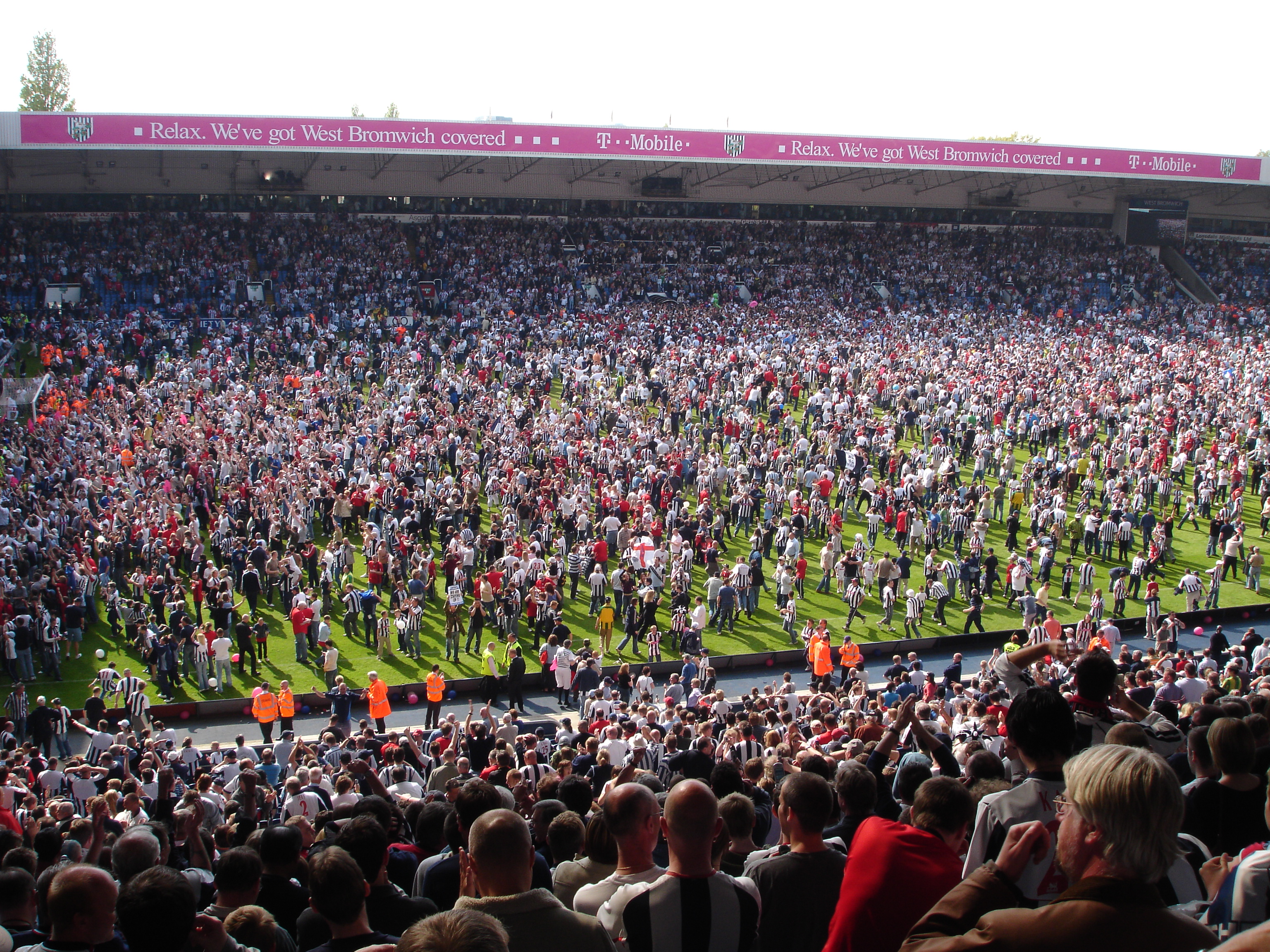
In the third tier, Ossie Ardiles' side won the 1993 play-offs, beating Port Vale 3–0 at Wembley, to return to the second level. Gary Megson, appointed in March 2000, transformed the club: promotion to the Premier League in 2001–02 after overhauling Wolves from 11 points behind, relegation in 2003, and an immediate return in 2003–04. Then came the Great Escape: under Bryan Robson, in 2004–05 Albion became the first Premier League club to survive after being bottom at Christmas and bottom on the final day, beating Portsmouth 2–0 on 15 May 2005 before a record all-seated Hawthorns crowd of 27,751. Relegation followed in 2006; Tony Mowbray lost the 2007 play-off final to Derby County, then won the Championship title in 2007–08, with an FA Cup semi-final the same season, was relegated in 2009, and Roberto Di Matteo brought Albion straight back up in 2009–10.
Eight Premier League Years, Relegation and the Patel Era (2010–present)
An eight-season continuous Premier League run followed under Roy Hodgson, Steve Clarke — whose side finished eighth in 2012–13, Albion's best Premier League finish — and Tony Pulis, who took them to tenth in 2016–17. Jeremy Peace sold the club to Lai Guochuan's Chinese investment group in 2016, and decline ended in relegation in 2017–18. Darren Moore's side lost the 2019 play-off semi-final on penalties to Aston Villa; Slaven Bilić won automatic promotion in 2019–20 but was sacked that December, and Sam Allardyce could not prevent relegation in 2020–21 — Albion's last Premier League season to date. Championship years followed under Valérien Ismaël and Steve Bruce, then Carlos Corberán, whose side finished fifth and reached the play-off semi-finals in 2023–24. In February 2024 Shilen Patel's Bilkul Football WBA acquired an 87.8% stake in the club, Patel becoming chairman and ending the Lai era; Corberán left for Valencia on Christmas Eve 2024. The Baggies' history — one title, five FA Cups and a League Cup — remains one of the richest of any club outside England's traditional giants.
Honours
| Trophy | Titles | Years |
|---|---|---|
| First Division (league title) | 1 | 1919–20 (runners-up 1924–25, 1953–54) |
| FA Cup | 5 | 1887–88, 1891–92, 1930–31, 1953–54, 1967–68 |
| League Cup | 1 | 1965–66 (runners-up 1966–67, 1969–70) |
| FA Charity Shield | 2 | 1920, 1954 (shared) |
| Second Division / Championship (second tier) | 3 | 1901–02, 1910–11, 2007–08 |
| Third-tier play-offs | 1 | 1993 |
Timeline
- 1878 — West Bromwich Strollers are formed by George Salter's Spring Works workers; first match 23 November 1878 vs Hudson's (0–0). Renamed West Bromwich Albion in 1880.
- 1888 — FA Cup winners for the first time (2–1 vs Preston North End) and one of the twelve founder members of the Football League.
- 1892 — Second FA Cup (3–0 vs Aston Villa) and the record 12–0 league win over Darwen — still the joint widest top-flight margin.
- 1900 — Move to The Hawthorns; first match 1–1 vs Derby County on 3 September 1900. The ground, at 551 feet, is England's highest league ground.
- 1919–20 — Champions of England for the only time, with record totals of 104 goals and 60 points under Fred Everiss.
- 1931 — The unique double: FA Cup winners (2–1 vs Birmingham) and promotion from Division Two in the same season — never repeated.
- 1954 — The "Team of the Century" win the FA Cup (3–2 vs Preston) and finish league runners-up to Wolves.
- 1966–1968 — League Cup winners at the first attempt in 1966 (5–3 aggregate vs West Ham), then FA Cup winners in 1968 — Jeff Astle's extra-time goal beats Everton; Tony Brown plays in both triumphs.
- 1978–79 — Ron Atkinson's side finish 3rd and reach the UEFA Cup quarter-final; Regis, Cunningham and Batson — the "Three Degrees" — make history together.
- 2005 — The Great Escape: Bryan Robson's Albion survive on the final day after being bottom at Christmas and bottom at kick-off on the last day.
- 2008 — Championship champions under Tony Mowbray (with an FA Cup semi-final); further promotions follow in 2010 and 2020, the latter under Slaven Bilić.
- 2024 — Shilen Patel's Bilkul Football WBA acquires 87.8% of the club in February 2024, ending the Lai Guochuan era; Patel becomes chairman.
References
- Wikipedia — "West Bromwich Albion F.C." (history, honours and records).
- Wikipedia — "List of West Bromwich Albion F.C. records and statistics" and "The Hawthorns".
- West Bromwich Albion — wba.co.uk, history of The Hawthorns and Tony Brown features.
- Wikimedia Commons — file pages for the photographs used.
Image source: Wikimedia Commons.


